Part one — the man who owned everything
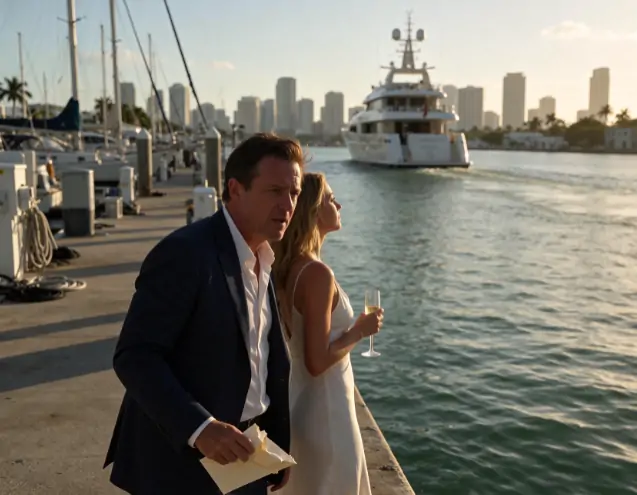
Four in the afternoon in Miami and the light came off the bay hard enough to hurt. It lay along the hull of the Serenità, got into forty champagne flutes, and found the woman standing alone under the aft awning where the shade was.
Daniel didn't look at her. Looking at her would have spoiled it.
He stood at the rail with his jacket open, one shirt button past respectable, his hand at the small of Celine's back in a way that suggested the boat, the afternoon, and the woman had all been paid for in the same transaction. Celine laughed at something he said. Too loud, but the guests were drinking and nobody keeps count of volume at four in the afternoon.
"Tell them," Daniel said, waving his glass at the deck, "tell them what I said about the mooring fees."
"He says he doesn't even notice them."
The guests laughed. Somebody raised a toast, somebody took a photograph, and the marina went on doing what marinas do: masts in rows, rope ticking against the mast, water slapping at the hull.
Then Daniel turned. Men like him turn slowly, so the room can watch them do it.
"Darling." Warm voice, carrying. "Come and say hello to Celine. She's been dying to meet you."
Celine turned her head and her smile was careful, the way a knife looks when you hand it over handle-first.
Nora looked at the two of them for a while. Long enough that one of the guests put his glass down. Then she lifted hers an inch off the rail.
"I've met her."
The deck went quiet. Not wind quiet. The other kind.
Daniel laughed first, because somebody has to. "She's tired," he said, mostly to the guests. "She's always tired. Runs the house, runs the schedules, runs..." He let it hang. "Everything except this."
He tapped the rail. Teak rang under his ring.
"This is mine."
Part two — one signal
Nora set her glass on the rail. Not slammed. Set it, in the ring of water it had already made, and then raised her right hand toward the wheelhouse: two fingers, a flick, the gesture you use for a waiter.
Nobody noticed. Guests see what they're handed.
Daniel was still talking about the engine refit when the engines changed pitch. Not a roar. A low settling, felt through the deck plates before it was heard, the sound of something deciding to move without asking anyone. The champagne shivered into rings in forty glasses.
Daniel stopped mid-sentence.
"Who told them to—" He turned toward the bridge. "Who told them to cast off?"
The gangway retracted. Steel on steel, and the white arm that had held the yacht to Florida folded back into the hull.
The gap opened. Four inches, then a foot, then three feet of green water, and the dock started becoming a place you look at from a distance.
Daniel's smile didn't fall. It went out, all at once, and what it left behind was worse: the face of a man doing arithmetic.
"Nora."
She walked forward along the deck. Past the guests, past Celine, unhurried, and stopped a few feet from him. Up close she was smaller than he remembered. That had always been the trick of her.
"Where are we going?" he said. "Nora. Where is this going?"
"Nowhere. You're not going anywhere. You're getting off."
A crew member appeared at his elbow. Young, polite, invisible for six years, suddenly the most important man on the boat, holding out a cream envelope with both hands.
Daniel looked at it. Didn't take it.
"What is this."
"Read it on the dock."
"I own this yacht."
"You own a good suit," Nora said, "a phone, and a car I'm letting you keep. The Serenità is registered to a holding company. The holding company answers to a trust. The trust answers to me. It has always answered to me." She said it the way you'd explain a bill. "You've been a guest here, Daniel. Eleven years. A very loud guest."
He took the envelope then, tore it, and the pieces went over the rail and turned in the air and dropped.
"There are copies," she said.
"I don't care."
"There are always copies."
She raised her hand again, the same flick, and the yacht answered her the way a boat answers the person who pays the crew.
"Your time aboard is over."
Part three — the dock
They put him off at the fuel pier, because the main dock was busy.
Not the grand eviction that did it. The fuel pier. A golf cart. A bored attendant in a hi-vis vest holding two suit bags like they were somebody's dry cleaning.
Celine came with him, for about ninety seconds.
She stood on the hot concrete in her heels and the white dress, still holding her glass, because nobody had taken it off her and it hadn't occurred to her to put it down. She looked at the yacht, then at Daniel, then at the yacht.
"Daniel. What did you tell me."
"Shut up."
"You said you bought it." Her voice climbed and broke on the last word. "You said you bought all of it."
"I said shut up."
The champagne trembled in her hand. A fast, fine tremor that put rings on the surface and wouldn't stop, and she stared down at it as though it had said something out loud.
He reached for her arm. She stepped out from under his hand the way you step away from a spill.
"Don't."
"Celine."
"Don't touch me." She laughed. Same laugh as the deck, except there was nothing under it now. "You don't have a boat. You have two suit bags and a phone."
She walked. Heels on concrete, not slowing, and the glass went into a bin without her breaking stride.
Daniel stood on the fuel pier in the gold light with an envelope he'd torn and couldn't un-tear, and the sun that had been money an hour earlier was just heat, on his neck, and there was nowhere to put his hands.
Out past the breakwater the Serenità came round into the light.
Nora went up to the bow. Wind in her hair, crew moving quietly around her, the guests standing well back. Every one of them had been invited by the wife, it turned out. She put one hand on the rail and watched the city shrink, and the marina with its little pier, and the man on it.
No shouting. No scene. Nobody's neighbours got a story out of it.
She had signed one page that morning, and said nothing to anyone for eleven years.
Somebody behind her asked whether the schedule for the season had changed.
"No," Nora said, watching the sun go down into water she owned. "Same schedule. One fewer passenger."