This is an original work of fiction. Characters, companies, and events are invented.
My husband stopped me outside the ballroom where I had spent three weeks managing his company gala and handed me a silver hotel badge.
"Just for tonight," Miles said. "If anyone asks, you manage the house."
I was still holding the midnight-blue dress I planned to change into after the final vendor check. Through the doors behind him, two hundred guests drank champagne under chandeliers I had personally inspected that morning.
"You want me to pretend I clean your house?"
"House manager sounds professional." He lowered his voice. "Please do not turn one awkward misunderstanding into a scene."
I was the night operations manager at the Halcyon Hotel in Chicago. I scheduled security, approved overnight contractors, and coordinated events too complicated for the daytime staff to finish before five. Miles knew my title. He had watched me take calls during dinner for four years.
His software company had booked the Halcyon for a charity gala benefiting neighborhood computer labs. I negotiated the ballroom schedule, found a replacement caterer after the first one canceled, and resolved a fire-capacity problem when his team added twelve sponsor tables without telling us.
Miles called my work "making the room behave." I used to think that was admiration.
Part 1
A woman in a white gown appeared behind him. I recognized Celeste Ward from business magazines and from a photograph that had stayed on Miles’s company website longer than our engagement.
Celeste had helped launch the company. She and Miles dated briefly before I met him. At last year’s investor retreat, someone assumed they were still together. Miles told me correcting every old impression was exhausting and irrelevant.
Apparently it was relevant enough to erase his wife.
"Celeste is here as a donor," he said quickly. "A few people expect a certain picture. We announce us after the financing closes."
We had been married eleven months.
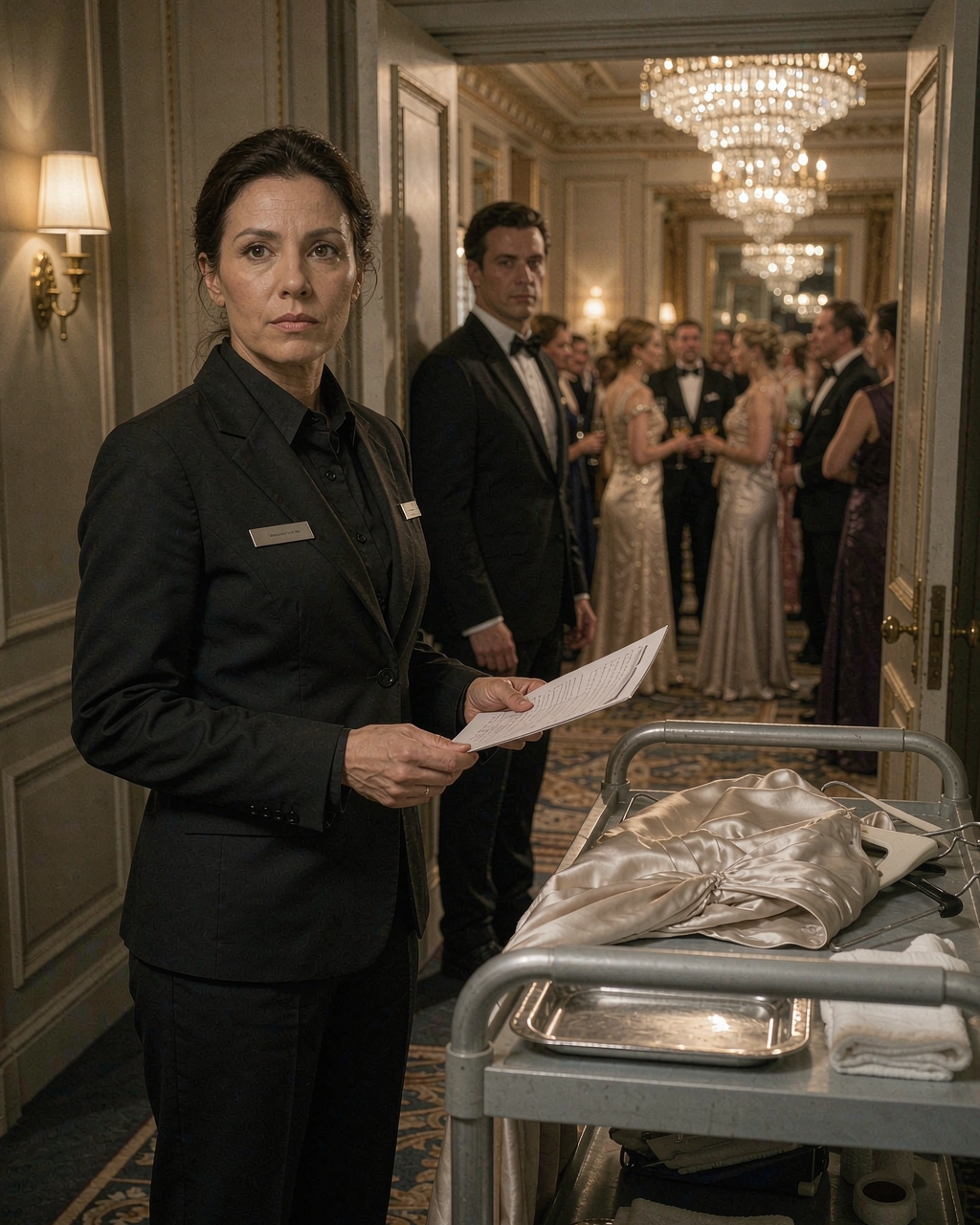
The event coordinator, Nia, hurried over with the final staffing sheet. "Elena, catering needs approval on the service change."
I glanced down. Beside my name, the role HOTEL OPERATIONS MANAGER had been crossed out. The replacement read CONTRACTED DOMESTIC STAFF—MERCER RESIDENCE.
The digital approval code belonged to Miles.
Three days earlier, his assistant had requested a corrected guest-facing version of the staffing list. I had approved removing employee phone numbers. I had not seen this version.
The clue had been sitting in front of me. Miles asked why my surname remained Alvarez on hotel documents. He requested extra staff uniforms in my size. He told me not to post photographs from the ballroom until Monday. Each request had arrived separately, wrapped in event logistics.
"You planned this," I said.
"I planned around a temporary perception problem."
I called my general manager, Priya Shah, and asked her to meet me in the service corridor. Miles reached for my elbow. I stepped back far enough that Nia noticed.
"If you walk away now, you jeopardize the grant announcement," he said.
"Your grant announcement has another hotel manager. What you need from me is not labor. It is participation in a lie."
Part 2
Priya arrived with the signed event contract on her tablet. The company had received my employee rate because I disclosed that the client was my spouse. Our policy allowed the discount if another manager approved billing and I did not receive a commission.
Miles’s edited staffing sheet created a different problem. It represented a hotel employee as his personal domestic worker while using her employment benefit. Priya did not make a speech about my marriage. She asked one operational question: could I continue supervising the event objectively?
"No," I said.
I transferred control to Nia, gave her the vendor passwords, and documented every unresolved issue. I did not sabotage the gala or order staff to stop serving. The hotel had a contract with the company, not with my pride.
Priya replaced the discounted room charges with the standard contracted rate pending review. Miles stared at the revised estimate.
"You are charging me eighteen thousand dollars because your feelings are hurt?"
"The hotel is correcting a rate based on a disclosure you changed," Priya said. "Elena is off the account."
I changed into my blue dress in the employee locker room. Not because Miles asked me to attend, but because my name already appeared in the printed program under event operations. If I disappeared in uniform, his version would become the only version.
I entered during the sponsor reception and introduced myself to the foundation director.
"I am Elena Alvarez, night operations manager here and Miles Mercer’s wife," I said. "Nia Coleman is now managing the event. She will take excellent care of you."
That was all. No microphone. No thrown drink.
Celeste found me near the coatroom. She looked angry, but not at me. Miles had told her I was a live-in employee he married for health insurance after an immigration problem. I was born in Milwaukee. I had my own insurance.
She showed me a message in which Miles asked her to stand beside him for photographs because investors responded well to "founder continuity." Celeste had assumed his marriage was a private arrangement I understood.
We did not become instant friends. We exchanged copies of the messages we each owned and agreed that neither of us would cover for him.
I left before dinner and went to the apartment Miles and I leased together. I photographed my personal documents, packed clothes for two weeks, and moved into an employee-rate room at another property in our hotel group. I left the apartment keys with the building desk and emailed Miles that I would communicate about the lease in writing.
Part 3
The financing did not collapse because investors learned their founder had a hotel-manager wife. It stalled because Celeste told the board Miles had used her image without disclosing that he was married, while the hotel documented altered event records. His need to control the picture became the risk.
The company postponed the announcement and hired an outside communications firm. Miles remained chief executive, but the board required someone else to approve public claims involving founders and major investors.
He came to the hotel two nights later with flowers. Security called me instead of sending him upstairs.
Miles apologized for "poor wording." I asked him to name the decision.
After several attempts, he said, "I decided being seen as married to you was less useful than being seen with Celeste."
That sentence ended the part of me still searching for a misunderstanding.
We separated. There was no secret fortune and no instant courtroom victory. We divided furniture, paid a fee to end the apartment lease, and spent five months negotiating ordinary financial details. I kept my retirement account. He kept his company shares. We each paid our own attorney from our own income.
The hotel review cleared me of wrongdoing because I had disclosed the relationship and removed myself when objectivity became impossible. Priya did give me a written warning for not escalating Miles’s unusual uniform request earlier. She was right. Love had made me treat a policy concern as a marital quirk.
Six months later, I was promoted to rooms director at a smaller sister property. The job came with fewer chandeliers and more plumbing emergencies. I liked it.
Celeste returned to product consulting under a contract that prohibited the company from using her likeness without approval. We occasionally exchange professional messages. We do not discuss Miles unless a document requires it.
The silver badge sits in an evidence envelope with the staffing sheet. I do not keep it as a trophy. It reminds me how humiliation often arrives: not as one shocking request, but as a series of small accommodations that make the final lie seem administratively convenient.
Miles wanted a wife who could make any room behave and then disappear from it. He learned too late that managing a room also means knowing exactly when to close it.