Part 1
At our tenth-anniversary dinner, my husband, Mark, sat beside me as his mother, Denise, thanked me for giving her the room that paid nearly half our mortgage.
Denise leaned across the white tablecloth and squeezed my hand. "I know the studio means a lot to you, Claire. I promise I won't be in your way."
For one stupid second, I thought she meant the watercolor class she had started at the community center.
Then she placed a brass key beside my plate.
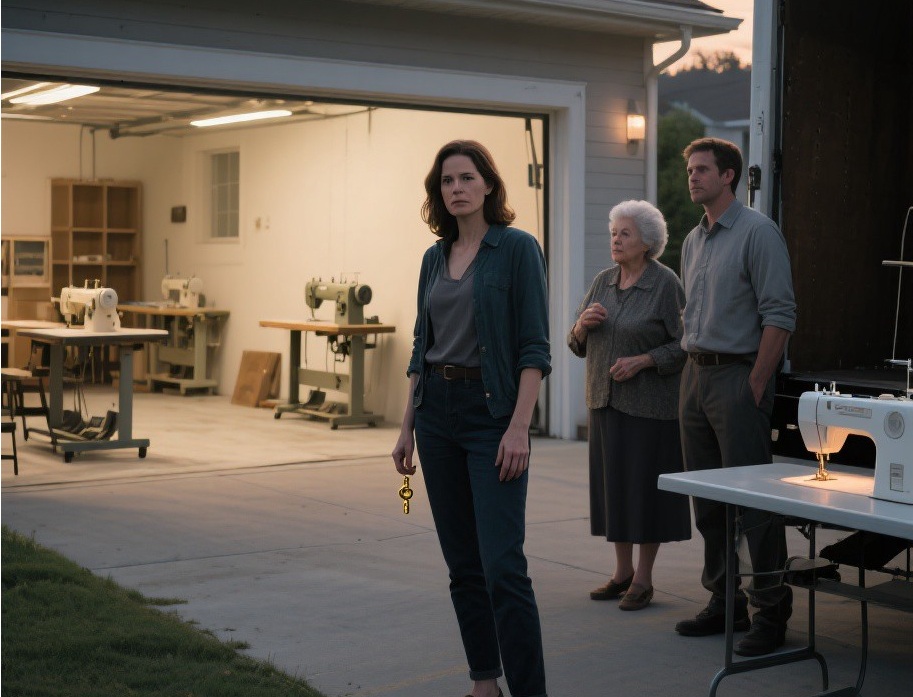
I recognized the blue paint caught in its teeth. The key opened the converted garage behind our house, where I ran my alterations business. That twelve-by-twenty room held two industrial sewing machines, six wedding gowns, and fifteen years of relationships with local bridal shops.
My husband, Mark, kept cutting his steak.
"You gave your mother a key to my studio?" I asked.
He finally looked up. "Our studio. And only for a few months. Mom accepted an offer on her house."
That was the first time anyone had mentioned an offer.
Denise's smile weakened. "Mark said you were excited about helping."
Mark reached for my wrist under the table. I moved my hand to my lap.
"When are you moving?" I asked Denise.
"Monday. The buyers wanted a quick closing, so Mark's friend handled everything."
Monday was three days away.
I pictured the boxes that had arrived at a storage unit Mark rented in September. He had called them camping supplies. I remembered a contractor leaving our driveway two weeks earlier and Mark saying the water heater needed an estimate.
"Where will my equipment go?" I asked.
Mark exhaled as if I were making the evening difficult. "The basement. We can make it work."
Our basement stairs turned sharply at the bottom. My larger machine weighed more than two hundred pounds. The basement also flooded during heavy spring rain.
Denise looked between us. "I can stay with my sister, Ruth, if this is a problem."
"It isn't," Mark said before I could answer.
There it was: my work, my answer, and my boundary, all volunteered by someone else.
I did not raise my voice. I asked for the contractor's estimate. Mark said we would discuss it at home. I asked Denise when she had listed her house.
"I didn't," she said. "Mark's college friend made a direct offer. Mark told me waiting would only complicate things."
Mark had not made one careless promise. He had built an entire plan around my silence.
Part 2
I paid my half of dinner and drove home alone.
Inside the studio, I opened every cabinet and photographed every dress, receipt, and machine serial number. Then I pulled up an email I had saved six months earlier from Harbor Workrooms, a licensed shared space downtown.
I had toured it when Mark complained that clients took too many parking spaces. The rent was $1,150 a month, including utilities and secure storage. At the time, staying home seemed cheaper.
At 10:18 p.m., the manager answered my call. A private room had opened that week. I paid the deposit from my business account.
My assistant, Tasha, arrived with her brother's delivery van before midnight. We moved every client's garment first, then the machines, cutting tools, mirrors, and files. I sent each client the new address and offered free pickup for the inconvenience.
My second call was to our bank's after-hours line. I could not remove Mark from a joint account, and I did not try. I redirected future business deposits to the business checking account that already existed in my name and left enough in joint checking to cover my agreed share of the next month's bills.
My third call was to a locksmith. The studio contained no client property by then, but the exterior door still connected to our fenced yard. I scheduled a lock change for Monday afternoon, after Denise's planned arrival, and asked for separate keys for the house and studio.
Mark came home at 12:40. He stood in the empty studio, staring at pale rectangles where shelves had been.
"What did you do?"
"Protected my clients and moved my business to a legal workspace."
"You emptied it just to punish me?"
"You arranged construction in an occupied business without telling its owner. Moving was the only way I could meet my deadlines."
He said the new rent was a waste of family money.
I showed him the last twelve months of transfers from my business into our joint account. Then I showed him the automatic transfer I had scheduled for my half of the mortgage, utilities, and groceries.
"The remainder will now pay for the workspace your decision made necessary," I said.
At 7:10 Monday morning, a moving truck backed into our driveway.
Denise stepped out holding the brass key. Mark stood beside her in sweatpants, looking relieved until he saw the empty room.
The contractor arrived ten minutes later and refused to begin. Mark had described the studio as an unfinished garage, but it had insulated walls, electrical upgrades, and built-in work surfaces. The contractor said plumbing and occupancy changes would require plans and local approval before he could quote the job accurately.
Denise slowly lowered her suitcase.
"You said the shower would be ready," she told Mark.
"Claire moved everything to make a point."
"No," I said. "I moved everything because six brides should not lose their dresses while you test whether an unapproved bedroom can be built in three days."
Part 3
Denise asked to see the basement. She made it halfway down before the steep turn forced her to grip the rail with both hands. Her arthritis had worsened, something Mark knew and I did not.
Back in the kitchen, I put coffee on and asked Denise what she actually needed.
Denise's house sale would close Friday. After paying the remaining mortgage, moving costs, and a small credit-card balance, she could afford an apartment, but she feared living alone after a recent fall. Mark had told his mother that our studio was the permanent answer and that I had suggested it.
I was angry with her for accepting my room without speaking to me. I was angrier with Mark for making honesty seem unnecessary to both of us.
Denise called her sister, Ruth, from our kitchen and arranged to stay there for two weeks. That afternoon, Denise and I toured two senior apartment communities near her doctor and one regular apartment near our neighborhood. Denise chose the regular apartment, which had an elevator and cost $1,420 a month. Her pension and Social Security could cover it, though the budget would be tighter than her old one.
I helped her compare the numbers. I did not offer my studio again.
"I chose not to let you dispose of my work," I said. "Your mother found housing because she participated in the decision. You created the emergency because you wanted gratitude from her without disagreement from me."
I asked Mark to attend marriage counseling and to disclose any other financial commitments he had made. Mark refused counseling at first. Then Denise called her son.
Denise had found Mark's messages urging her to accept the quick offer before "Claire starts worrying about details." She told Mark she would not move into our home even if I offered. Denise also told her son that making his mother dependent on a lie was not an act of care.
Mark agreed to counseling the next morning.
Counseling produced a list: no copied keys, no promises involving shared property without two yeses, and no family expense above $300 without discussion. My business would contribute a fixed monthly amount to household costs.
In our fourth session, Mark admitted he had treated my work as flexible because I worked behind our house.
I told him permanence was not the same as importance.
We stayed separated for six weeks while he lived with a friend. That was not theater. I needed to learn whether peace returned when he left, and he needed to decide whether he wanted a partner or a person who absorbed consequences for him.
He came home only after we signed a written household agreement and he apologized to my staff and to Denise without asking either of us to comfort him.
A year later, Harbor Workrooms costs more, but it gave me room to hire a second tailor. Revenue rose enough to cover the rent.
The old studio is not Denise's bedroom. It is a shared family room with a desk for Mark and a painting corner for me. Denise visits on Sundays from her apartment four blocks away, using the front door after she rings the bell.
The brass key sits in a small frame on my office shelf.
It is not a trophy. It is a reminder that a boundary explained after someone crosses it is still a boundary, but a boundary enforced by action is the one people finally learn to see.