Part 1
At our tenth-anniversary dinner, my husband, Mark, sat beside me while his mother, Denise, thanked me for handing over the room whose earnings had been covering nearly half our mortgage.
Denise leaned across the white tablecloth and squeezed my hand. “I know how much the studio means to you, Claire. I promise I won't be in your way.”
For one foolish second I thought she meant the watercolor class she had signed up for at the community center.
Then she set a brass key beside my plate.
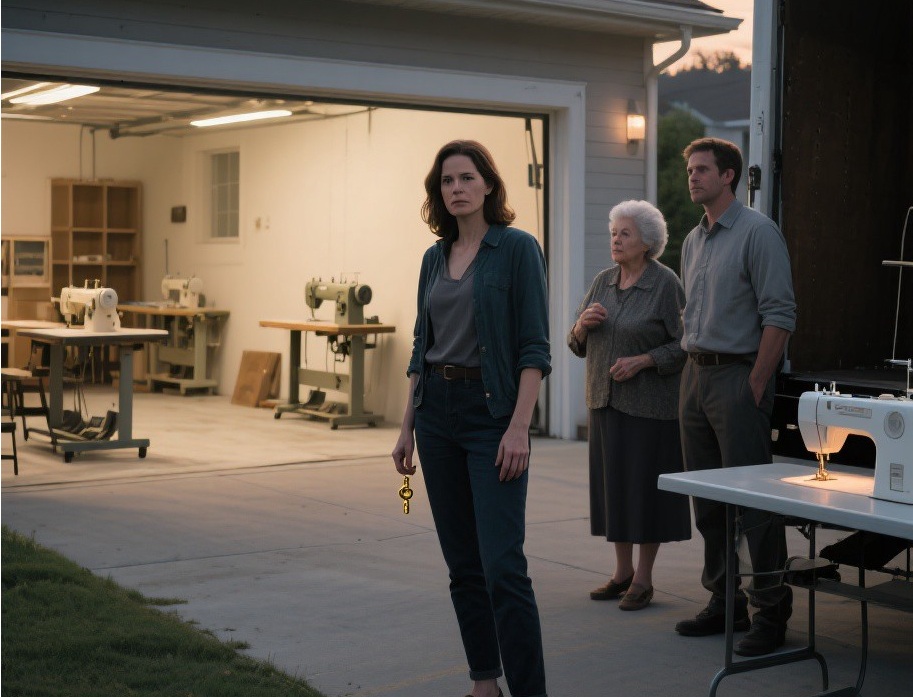
I recognized the blue paint caught in its teeth. That key opened the converted garage behind our house, where I ran my alterations business: a room twelve feet wide and twenty feet deep, holding two industrial sewing machines, six wedding gowns, and fifteen years of relationships with local bridal shops.
Mark kept cutting his steak.
“You gave your mother a key to my studio?” I asked.
He looked up then. “Our studio. And only for a few months. Mom accepted an offer on her house.”
That was the first I had heard of any offer.
Denise's smile thinned. “Mark said you were excited to help.”
Under the table, Mark reached for my wrist. I moved my hand to my lap.
“When are you moving?” I asked her.
“Monday. The buyers wanted a quick closing, so Mark's friend handled everything.”
Monday was three days away.
I thought about the boxes that had arrived at the storage unit Mark rented in September. Camping gear, he had called them. I thought about the contractor pulling out of our driveway two weeks earlier, and Mark saying the water heater needed an estimate.
“Where does my equipment go?” I asked.
Mark sighed as if I were the one making the evening difficult. “The basement. We'll make it work.”
The basement stairs turned sharply near the bottom. My larger machine weighed over two hundred pounds, and the basement flooded whenever it rained hard in spring.
Denise looked from him to me. “I can stay with my sister Ruth if this is a problem.”
“It isn't,” Mark said before I could answer.
There it was: my work, my answer, my boundary — all supplied by someone else.
I did not raise my voice. I asked for the contractor's estimate, and Mark said we would talk at home. I asked Denise when she had put her house on the market.
“I didn't,” she said. “Mark's college friend made an offer directly. Mark told me that waiting would only complicate things.”
This was not one careless promise. Mark had built an entire plan around my silence.
Part 2
I paid for my half of dinner and drove home alone.
Inside the studio, I opened every cabinet and photographed every dress, every receipt, every machine serial number. Then I pulled up an email I had saved six months earlier from Harbor Workrooms, a licensed shared workspace downtown.
I had toured it back when Mark complained that my clients took up too many parking spaces. The rent was $1,150 a month, utilities and secure storage included. Staying home had seemed cheaper at the time.
At 10:18 that night, the manager answered my call. A private room had opened up that week. I paid the deposit from my business account.
My assistant, Tasha, arrived with her brother's delivery van before midnight. We moved every client garment first, then the machines, the cutting tools, the mirrors, and the files. I sent each client the new address and offered free pickup and delivery to make up for the disruption.
My second call was to the bank's after-hours line. I could not remove Mark from a joint account, and I did not try. I redirected future business deposits into the business checking account that already carried my name, and left enough in the joint account to cover my agreed share of the next month's bills.
My third call was to a locksmith. No client property remained in the studio by then, but the exterior door still opened onto our fenced yard. I scheduled a lock change for Monday afternoon, after Denise's planned arrival, and asked for separate keys for the house and the studio.
Mark came home at 12:40. He stood in the empty studio, staring at the pale rectangles where the shelves had been.
“What did you do?”
“Protected my clients and moved my business to a legal workspace.”
“You emptied it just to punish me?”
“You scheduled construction in an occupied business without telling its owner. Moving was the only way I could meet my deadlines.”
He said the new rent was a waste of family money.
I showed him the last twelve months of transfers from my business into our joint account. Then I showed him the automatic transfer I had set up for my half of the mortgage, the utilities, and the groceries.
“The remainder now pays for the workspace your decision made necessary,” I said.
At 7:10 on Monday morning, a moving truck backed into our driveway.
Denise climbed out holding the brass key. Mark stood beside her in sweatpants, looking relieved until he saw the empty room.
The contractor arrived ten minutes later and refused to start. Mark had described the studio as an unfinished garage, but it had insulated walls, upgraded wiring, and built-in work surfaces. The contractor said the plumbing and the change of use would require drawings and local approval before he could quote an accurate price.
Denise lowered her suitcase slowly.
“You said the shower would be ready,” she told Mark.
“Claire moved everything to make a point.”
“No,” I said. “I moved everything because six brides should not lose their dresses while you find out whether an unapproved bedroom can be built in three days.”
Part 3
Denise asked to see the basement. She got halfway down before the sharp turn forced her to grip the railing with both hands. Her arthritis had gotten worse — something Mark knew and I did not.
Back in the kitchen, I put the coffee on and asked Denise what she actually needed.
Her house would close on Friday. After paying off the remaining mortgage, the moving costs, and a small credit-card balance, she could afford an apartment, but after a recent fall she was afraid of living alone. Mark had told his mother that our studio was the permanent answer and that I had suggested it.
I was angry at her for taking my room without speaking to me. I was angrier at Mark for making honesty seem unnecessary to both of us.
Denise called her sister Ruth from our kitchen and arranged to stay with her for two weeks. That afternoon she and I toured two senior apartment communities near her doctor and one ordinary apartment near our neighborhood. She chose the ordinary one, which had an elevator and cost $1,420 a month. Her pension and Social Security would cover it, though the budget would be tighter than before.
I helped her work through the numbers. I did not offer the studio again.
“I chose not to let the two of you dispose of my work,” I said. “Your mother found housing because she took part in the decision. You created the emergency because you wanted her gratitude without disagreement from me.”
I asked Mark to attend marriage counseling and to disclose any other financial commitments he had made. At first he refused. Then Denise called her son.
She had found Mark's messages urging her to accept the quick offer before “Claire starts worrying about details.” She told him that she would not move into our house even if I offered. She also told him that making his mother dependent on a lie was not an act of care.
The next morning, Mark agreed to counseling.
Counseling produced a list: no copied keys; no promises involving shared property without two yeses; no household expense above $300 without discussion. My business would contribute a fixed monthly amount to household costs.
In our fourth session, Mark admitted that he had treated my work as flexible because I worked behind our house.
I told him that permanence is not the same as importance.
We stayed separated for six weeks while he lived with a friend. That was not theater. I needed to learn whether the peace returned when he left, and he needed to decide whether he wanted a partner or a person who absorbed the consequences for him.
He came home only after we signed a written household agreement and after he apologized to my staff and to Denise without asking either of us to comfort him.
A year later, Harbor Workrooms costs more, but it gave me room to hire a second tailor. Revenue rose enough to cover the rent.
The old studio is not Denise's bedroom. It is a shared family room with a desk for Mark and a corner for my painting. Denise visits on Sundays from her apartment four blocks away, coming in the front door after she rings the bell.
The brass key sits in a small frame on my office shelf.
It is not a trophy. It is a reminder that a boundary explained after someone crosses it is still a boundary — but a boundary enforced by action is the one people finally learn to see.