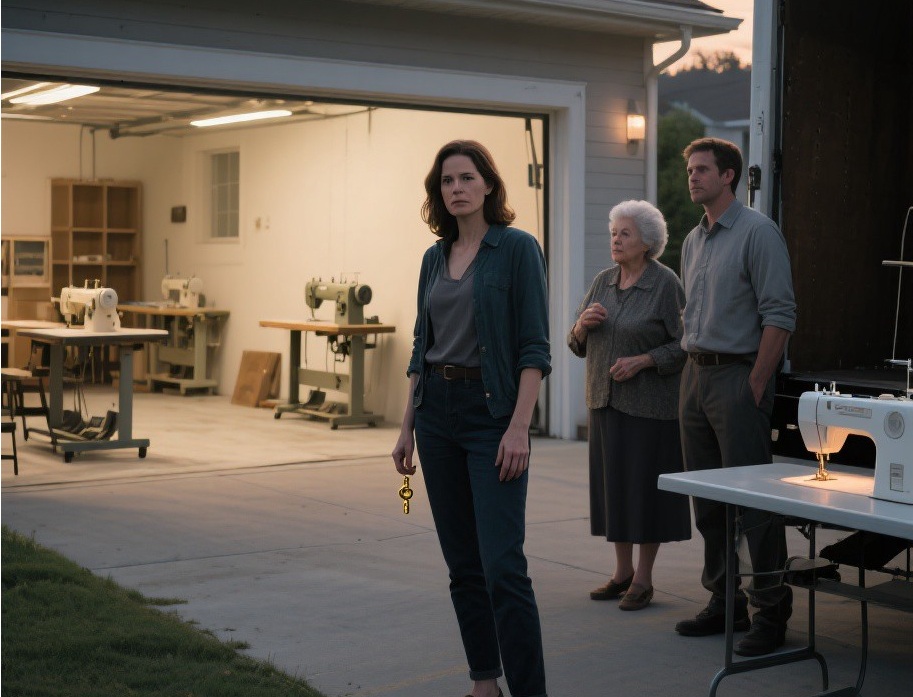
Three days before our vacation, Ryan handed my plane seat to his sister over the chicken parm I had spent two hours making, without once looking up from his plate. He could do that because I had spent twelve years paying for a life that ran entirely on his terms, and nobody in that house had ever thought to ask whose name was on anything. The ticket, as it turned out, was in mine.
"My family needs a break more than you do," he said. "You can stay home and watch the cat. Besides, you paid for the vacation because we're family, right?"

I had been married to that man for twelve years, and I thought I knew every form a person's disrespect could take. I was wrong, but only slightly. The new part was not the disrespect. It was that he had stopped bothering to hide it.
My name is Patricia, I am forty-four, and I live in a Columbus townhouse I inherited from my grandmother. For nineteen years I have worked as an office operations manager, and under our household rules, my salary covered the mortgage, taxes, groceries, utilities, repairs, and every family emergency.
Ryan's income was strictly his own, because, as he put it, a man's money was a man's money. I had tolerated that arrangement for years. I had also tolerated his mother Teresa, who reminded anyone who would listen that my only value was as a good worker. This time, I decided, the tolerance ended.
So when Ryan handed my ticket to his sister Dana, I did not argue. I did not cry. I did something better: I stayed calm, packed coolers of sandwiches and snacks for their drive to the airport, and waved them off with a smile.
Dana had gleefully claimed the seat, joking that a beach vacation was wasted on a woman with no children anyway. What none of them realized was that the ticket was booked in my name, under my frequent flyer profile, with identification to match.
I want to be clear that this was not a trap I built overnight. The ticket was simply mine, the way the mortgage was mine, the way the car insurance was mine. For twelve years nobody in that family had asked whose name was on anything, because the answer had never cost them anything.
Denied Boarding, Two Hundred Miles From Paradise
At the check-in counter, the agent asked Dana for identification matching the ticket. She produced her own license, which read Dana, not Patricia. The explanation that she was taking her sister-in-law's seat did not help. Airlines do not reassign tickets to different passengers at the counter, and standby options were priced beyond what Ryan was willing to pay, since, of course, his money was his own.【待补来源】
I have thought about that hour a lot. Three adults stood at a counter two hundred miles from the beach, holding a reservation they had never paid for, arguing with a woman behind a computer who kept repeating the same sentence about names. None of them had ever read the fine print, because someone else had always read it for them.
After an hour of escalating voices, the three of them drove home, furious, hungry, and holding eight nights of non-refundable nothing.
They burst through my door demanding answers. Why had I not transferred the ticket? Why had I let them drive all the way to the airport? I let the questions wash over me, then pointed at the dining table, where a single envelope sat beside the cold chicken parm.
The Note That Changed Everything
Inside the envelope was a letter I had drafted with an attorney two days earlier, the moment Ryan first spoke those words over dinner. It was a formal notice that I had filed for divorce, along with a key detail none of them had ever bothered to learn: the townhouse belonged solely to me, inherited from my grandmother and kept in my name throughout the marriage.
Ryan had no claim to it. The joint account, which my salary had funded for twelve years, had been divided that same morning under court supervision, with my documented contributions attached as evidence.
There was also a second, smaller note, handwritten, because some things deserve a personal touch. It read: "You said I paid for the vacation because we're family. I did. I paid for yours too, every single one, for twelve years. This is my receipt. Goodbye, Ryan."
The Fallout, Served With a Side of Justice
Dana tried to demand the hotel refund, since, in her words, the trip had been promised to her. I pointed out that the reservation was in my name, had been cancelled the previous morning with a partial refund issued to my card, and that no promise had ever existed. She had confused being told about a plan with being given one.
Teresa called me every name she could think of, then called back an hour later asking whether Ryan could retrieve his golf clubs. I mailed the golf clubs to her house the following week, postage paid, with a smile on my face the entire time at the post office.
Ryan moved in with his sister that same weekend. The divorce was finalized four months later, quick and clean, because the financial records told the story plainly: nineteen years of employment, twelve years of marriage, and a documented ledger of everything I had paid for while his income sat untouched in accounts he called personal. My attorney described it as one of the most one-sided contribution histories she had ever seen. The court agreed.
What I Learned About Quiet People
People ask why I stayed twelve years. The honest answer is that I kept believing the balance would shift, that appreciation would arrive eventually if I just kept everything running smoothly. It never did.
What finally changed was not Ryan. It was me, on an ordinary Tuesday, realizing that the vacation tickets I had paid for were being handed to someone else while I was told to stay home with the cat. The amount was not the problem. The assumption was.
I still have the cat. She sleeps on the windowsill of the sunroom where I now keep the plants Teresa once mocked. I took the vacation myself that September, alone, to the same beach, and spent eight nights eating seafood and reading novels, sending no photos to anyone.
On the last day, I raised a glass to my grandmother, who left me more than a townhouse. She left me proof that a woman can be generous for decades and still have a line she will not let anyone cross. My husband learned that too, at an airline counter, two hundred miles from a beach he will never see.
What I carry forward is a rule I did not have at forty-three. Before I pay for anything, I ask whose name is on it, and I say the answer out loud where everyone can hear. It ends a certain kind of conversation early, and it saves a certain kind of woman twelve years.