The man I accused of kidnapping my daughter was the only adult at that bus stop who saw the danger, and the danger was standing behind me. I screamed at a driver for ten minutes while a stranger in a gray hoodie watched from a parked van, and the deputy's question is the only reason I know how close I came to being right about the wrong thing. I am writing this because I have never forgotten how fast my fear ignited, or how completely it aimed me at an innocent man.
Before that Tuesday afternoon, a school bus had never frightened me. My daughter Daisy had ridden Route 18 since kindergarten without a single problem. Every school day I waited at Maple Drive and Pine Street, barely a minute from our house, and she was usually the last student off at the end of the run. On most afternoons she came down those steps already talking, her shoes barely touching the pavement before the stories started.
I was thirty-eight, raising Daisy alone, working as a scheduling coordinator at a medical clinic. Our routine was rehearsed down to the minute. That is probably why my body registered the wrongness before my brain did.
The Door That Shut
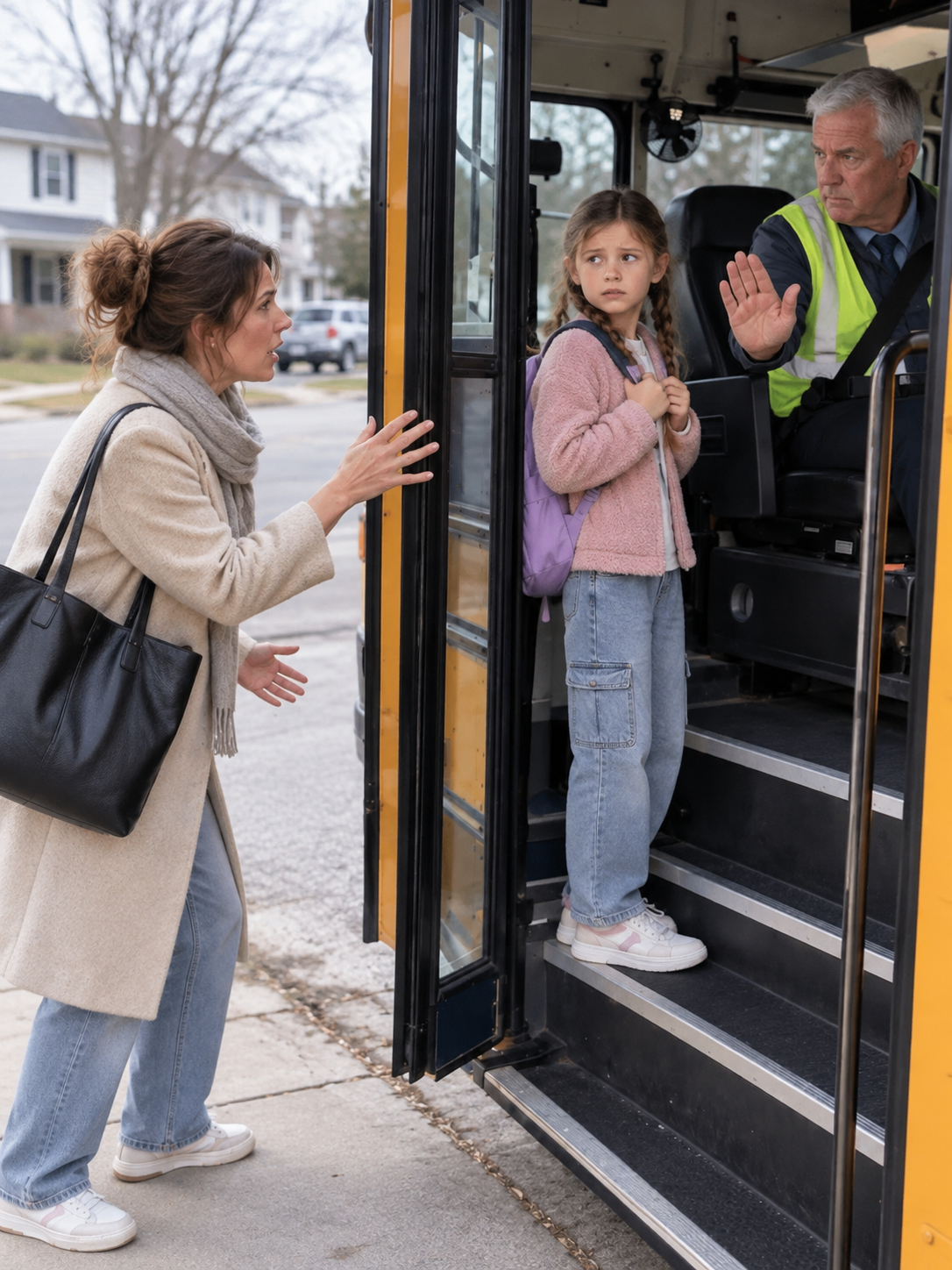
Daisy stood up from her seat and started toward the exit, and then the silver-haired driver rose from his seat, planted himself in the aisle, and shouted, "Please stay back! I need to keep her safe!" Moments later his voice hardened into something I will hear for the rest of my life: "You're not taking her!"
I stood just outside the folding doors, screaming that I was her mother, waving, showing him the pickup card I had carried for years. He looked directly at me, closed the doors, and drove off with my daughter crying behind the glass. My hands shook so violently it took three attempts to dial 911.
What I remember most clearly is not the fear. It is the certainty. I was not confused or uncertain for one second. I knew exactly what I had seen, I knew exactly what it meant, and I was completely wrong. That is the part nobody warns you about. Panic does not feel like confusion. It feels like clarity.
Deputies caught the bus within ten minutes. But when I demanded the driver be arrested on the spot, one of them asked me a question I could not answer: "Ma'am, who was the man standing behind you?"
The Man I Never Noticed
I told the deputy no one had been behind me. He turned his phone toward me, a grainy screenshot from a neighbor's doorbell camera, and there I was at the bus stop, and there, ten feet back, half-hidden behind a parked van, stood a heavyset man in a gray hoodie, watching Daisy's name on my pickup card.
I had been at that corner for several minutes. I had looked at my phone, at the bus, at my daughter's face in the window. I had not looked behind me once. Whatever instinct I thought I had, whatever vigilance I believed I practiced every afternoon, it had never once turned around.
The deputy explained what the driver had already reported: two weeks earlier, a man had loitered at several stops along Route 18, photographing children. The district had quietly briefed drivers. That afternoon, the driver spotted the same gray hoodie behind me and made a split-second call: hold the child, leave the area, call dispatch. He had protected Daisy from a stranger I never even saw.
The Call That Confirmed It
While deputies interviewed me at the district office, dispatch relayed word that a man matching the doorbell image had been stopped twelve blocks away carrying printed photos of schoolchildren from three different neighborhoods. He was taken into custody, and investigators later connected him to a pattern of surveillance around elementary schools. Prosecutors charged him with multiple offenses, and Daisy's name, thankfully, appeared nowhere in his materials. He had never gotten close enough.
I broke down in the parking lot, part relief, part shame. I had screamed at the one man standing between my daughter and real danger, while the actual threat stood quietly at my back.
What made the shame worse was how good it had felt to be angry. For ten minutes I had been the mother who fights, the one who does not let anything happen to her child, and the role fit so well that I never asked whether I was playing it in the right direction.
Meeting the Driver Again
The district arranged a meeting the following week. Mr. Alvarez, the silver-haired driver, had driven Route 18 for nineteen years and had never once raised his voice. He apologized for scaring Daisy, then added, "I'd rather apologize to you than explain to God why I didn't." Daisy, who had cried for two days about being "kidnapped by the bus," threw her arms around him before I could say a word.
I had rehearsed an apology, and it was useless the moment I sat down, because he had already decided not to need one. He apologized first, for a decision that saved my daughter's life, then spent the rest of the hour talking about Daisy as though the whole incident had happened to her and not to him. Nineteen years of driving, and the thing that worried him most was that a split-second call might have taught a child to be afraid of the ride to school.
The school district, embarrassed by how little parents knew, moved the protocol briefing public: drivers are trained that if a potential threat is spotted near a guardian, they delay release, relocate the stop, and contact law enforcement immediately. What looked like an abduction was, in fact, an act of extraordinary vigilance.
What Every Parent Should Take From This
I share this story because the lesson I learned is not the one I expected. Knowing the protocol matters, and I should have known it before I needed it. Teaching children that a trusted adult may sometimes act strangely on purpose to protect them matters too, so a delay at the bus door is not a reason to panic or bolt. But the lesson that changed how I stand at that corner is smaller and harder: I was watching the wrong direction the whole time, and no amount of love aimed the wrong way would have helped my daughter.
Daisy still rides Route 18. She still talks before her shoes hit the pavement. But every afternoon, she waves twice, once for me, and once for Mr. Alvarez, the quiet guardian behind the wheel who kept her safe when I could not. Trust took a moment to rebuild, but it did.
Our street learned its own lesson too. Neighbors now wait together at the corner, eyes open, phones ready, trading small talk and watchfulness in equal measure. We did not organize a meeting or start a group. We just stopped standing alone with our backs to the street, which, it turns out, was the entire vulnerability. The man in the gray hoodie counted on a corner full of parents facing one direction. He was right about us for two weeks, and then a bus driver was not.