"Ma'am. He's not coming." A soldier said those words to me at an arrivals gate while I held two babies on my hips, and for about four seconds I believed my husband was dead. He was not. He was three hundred miles away with his hands on a stranger's chest, and that fact — not the wait, not the war — is what I understand now about the man I married.
My husband never got to hold our daughters. They were born in March, when he was already nine months into his deployment, and he met them the only way he could: through a laptop screen with choppy audio, their faces pixelated and small. He used to say the hardest part was not the distance or the time zones. It was knowing they would recognize his voice before they ever recognized his face.
Tuesday, at Last
He was coming home on a Tuesday. Nine hours before his flight, he called from the connecting airport, waiting at the gate. "I miss you so much. I can't wait to see my little girls." Then a laugh: "Although apparently they're not that little anymore."
Then, quieter, the words he had repeated on every call since March: "I'm so sorry. I'm so, so sorry I wasn't there."
I told him to stop apologizing. What mattered was that he was coming back and his family would be at the gate. He sent me a video of himself boarding the plane, and I must have watched it a hundred times that night.
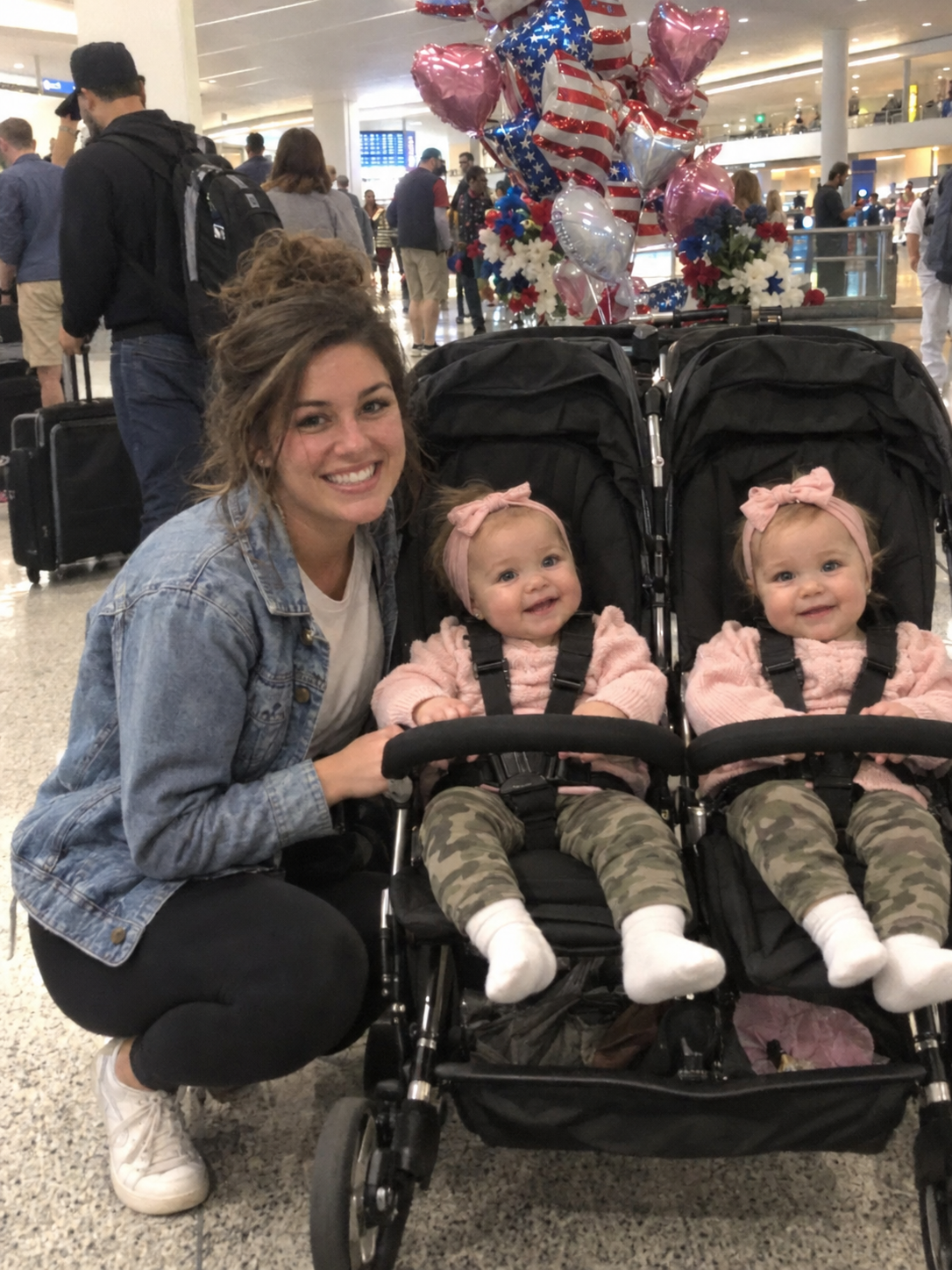
Monday brought no sleep at all. The twins wore matching outfits that said DADDY'S HOME, a gift from his mother. Three balloons were tied to the stroller, bobbing in the terminal air. I kept one eye on the flight tracker all night, following the little animated plane crawling across the map, and it occurred to me that a dot on a screen had never looked so much like a person.
At 6:40 a.m., the arrivals board flashed LANDED.
The Touch on My Shoulder
I stood at the arrivals gate with both girls on my hips, balloons straining against the stroller, heart hammering. Passengers streamed out in waves. Then a soldier in uniform appeared, moving with the slow, deliberate pace that military spouses learn to dread before they ever learn why.
He touched my shoulder gently. "Ma'am. He's not coming."
The terminal went white at the edges. The balloons kept bobbing. One of the twins laughed at something, that wonderful baby laugh, and it was the only sound in the world. The soldier kept talking, and his words arrived out of order: diverted, medical emergency, alive. It took me three full passes to work out which of those words belonged to my husband.
He was alive. Two hours into the flight, a passenger several rows behind my husband had suffered a cardiac event. The plane made an emergency diversion to another city hundreds of miles away. My husband, a trained combat medic, spent the rest of the flight and the entire landing assisting the medical response. He never made the connection.
The Longest 48 Hours
For two days I lived in the gap between the flight tracker and my phone. He called when he could, between ground stops and rebooking queues and a system overwhelmed by one diverted plane. The passenger survived. She was stabilized on the aircraft floor and alive when the ambulance took her, which I know because he told me, and because he would have told me either way.
"You should have seen the flight attendants," he said on the second night, exhaustion flattening his voice. "They never stopped. Nobody on that plane stopped."
He also said the thing I will never forget: "I spent nine months begging God to get me home to my girls. Then He put a dying woman between me and that gate. What was I supposed to do? I wasn't going to sit down."
His mother cried on my couch. My own mother drove through the night. The twins, oblivious to all of it, learned to blow raspberries in those two days, and I filmed it for a man three hundred miles away who watched it forty times and cried into the steering wheel of a rental car.
Thursday, Gate C
Thursday afternoon brought a different board, a different flight number, and the same gate I had camped at two days earlier. The twins wore the DADDY'S HOME outfits again, wrinkled now, slept in by impatient babies, perfect anyway.
The door opened. Passengers trickled out. Then a man in a rumpled shirt, carrying nothing but a duffel bag and nine months of accumulated hope, stopped dead when he saw the balloons.
He did not salute. He did not walk. He ran, past the pilots, past the strollers, straight to the two little girls who screamed with delight at this large, loud, unfamiliar-but-not-really voice they had only ever heard through a laptop. He held one twin in each arm, pressed his face into their hair, and shook like a man in a windstorm.
Then he looked at me over their heads. "I'm so sorry I wasn't there," he started, and for the first time in nine months I did not let him finish. "You were there," I said. "You were on that plane doing exactly what I married you for. Now come home."
What I Know Now
People still ask me about that morning at the gate, about the soldier's hand on my shoulder and those words landing in the middle of my chest. I tell them the sentence was incomplete. He was not coming on that flight. He was coming, a little late, a little rumpled, a hero twice over.
The woman from the plane sent us a card that Christmas. She is doing well. My husband frames things like that now: the card, a photo of three balloons tied to a stroller, the wrinkled DADDY'S HOME shirts from the second attempt. Our hallway looks like a museum of one very bad week that ended well.
The deployment took nine months from him and the diversion took two days. What stays with me is smaller and harder. He was never late because he forgot us. He was late because a stranger needed him more at that hour, and I have spent years since wondering whether I would have had the nerve to stay on that plane instead of running down the aisle toward my children. I would like to think so. I married the kind of man who did.