My daughter Maisie was four months old when her fever hit 104 degrees in the middle of the night, and the fight that followed in that emergency room had nothing to do with medicine. It had to do with who, in our family, was allowed to be tired. By the time my mother-in-law grabbed my husband's coat out of his hands and shouted at me in front of a full waiting room, I had already decided to stop translating for both of them.
I am thirty-one, a nurse practitioner in emergency medicine, so I knew a fever of 104.1 in a four-month-old was not something we could watch at home. Before Maisie was born I spent six years in emergency departments, and two years before that helping care for my mother after her early-onset Parkinson's diagnosis. Exhaustion and responsibility were not new to me. What was new was carrying them for two other people who had never agreed they were mine.
The Pattern I Married Into
My husband Lucas was loving, funny, and genuinely thoughtful, and he was the only child of Patricia Finch, a woman who had spent thirty-three years protecting him from every discomfort before he could learn from it. I had seen the pattern long before we had a baby. After I miscarried our first pregnancy, Patricia called Lucas daily to console him about how hard the loss must be for him, while I sat in the next room wondering whether she remembered who had been pregnant. I said nothing, because I wanted to protect my marriage.
When Maisie arrived, Lucas was the father I had hoped for. He changed diapers, shared night feedings, and learned to swaddle with obsessive concentration. Then a major project launch hit his office around her seventh week, and he began to recede — slowly and politely, in a way that was hard to argue with. I became the default parent, which is how it always happens: through small moments when one person is equally exhausted and the baby still needs feeding, changing, and comforting.
The Night Everything Came to a Head
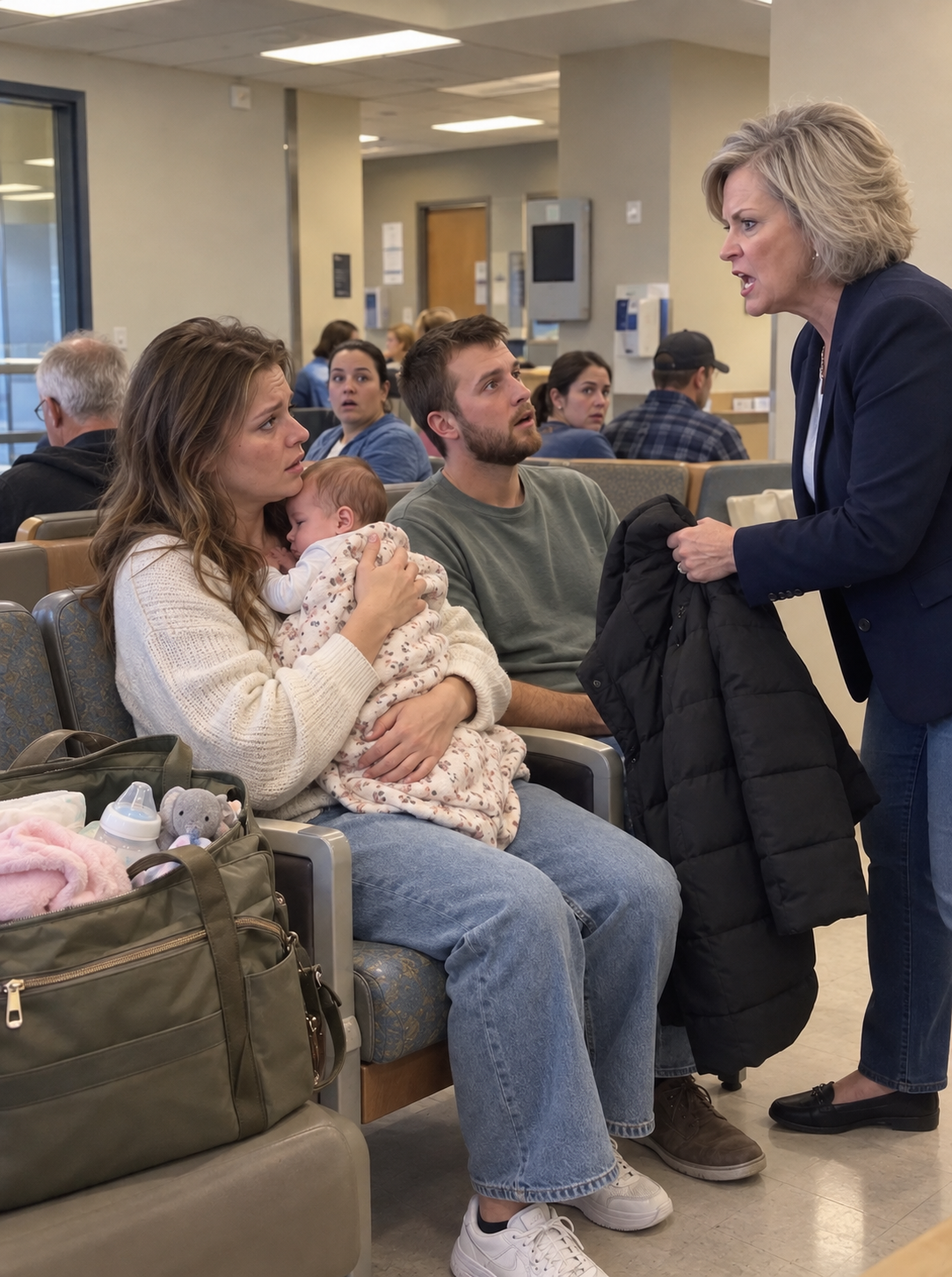
Maisie's fever started mildly on Thursday and kept climbing despite medication. At one in the morning the thermometer read 104.1, and her pediatrician told us to drive directly to Saint Luke Community Hospital in Phoenix. In the waiting room she cried against my chest, hoarse from hours of it, while Lucas paced and checked the time.
"This is ridiculous," he said, running a hand through his hair. "I have a massive presentation at nine AM, and I can't be sitting here doing this all night."
I remember staring at him with our feverish daughter burning against my collarbone and feeling something in me go very still. Before I could answer, the doors swung open and Patricia marched in, coat half off. She snatched Lucas's jacket out of his hands, fussed over him, and then rounded on me.
"He never agreed to deal with this much stress! You're the mother!"
There it was, stated plainly in a room full of strangers: his fatigue was a crisis, and mine was the job description.
What I Did Instead of Breaking
I did not defend myself. I turned to the triage desk and used the voice I use with frightened families at work. "My daughter is four months old, rectal temperature 104.1, fever unresponsive to medication for six hours. She needs to be seen now, and her father will be holding her while I register her."
Then I put Maisie into Lucas's arms, handed him the diaper bag, and stepped back to the desk. She screamed. He stood frozen in the middle of the room holding his wailing child, while his mother watched him look helplessly at me and realize in real time that he did not know her dose history, her last feeding, or her pediatrician's name. I did. I recited all of it from memory.
Patricia started to step in, and I finally spoke to her, quietly, without heat. "You're right that I'm the mother. So tonight, you can sit down and watch me do my job, or you can wait in the car. Those are the choices." She sat down. Maisie was seen within minutes, diagnosed with a serious but treatable viral infection, and admitted overnight for fluids and monitoring. Lucas, to his credit, stayed and held her for most of the night.
The Conversation That Followed
The next afternoon, while Maisie slept, I told Lucas the truth in plain sentences. I had become the default parent. His exhaustion was real and so was mine. And if I ever again heard my job described as stress I had never agreed to, we would be seeing a counselor before we saw another holiday.
He did not defend himself, and he did not promise to be different in general terms. He asked what the nights should look like. That question mattered more than an apology, because it meant he had finally understood that the schedule was a decision and not weather.
I spoke to Patricia later, on my own terms, without Lucas in the room. Her son was not a child to be protected anymore; he was a father, and every time she rescued him from a consequence she stole a chance for him to grow. She did not thank me. She also never grabbed his coat again. That was the hardest conversation of my life, and the most necessary, because it moved the argument out of the waiting room.
What I Would Tell Any Parent in That Room
If you are the one who knows the dose history, say so out loud, and then hand over the baby. If you are the one who is tired, say that too, but not as a reason to leave the room.
Maisie is older now and has no memory of that night. I remember it for both of us, and what I remember is not the shouting. It is the moment I stopped explaining my husband to his mother and let him hold his daughter while I did the one thing nobody in that room could do for me. The fever broke. The arrangement did not survive intact, and it should not have.