Part 1
My fiance, Adrian Vale, invited me to Northstar Hospitality's winter gala. Adrian was the company's CEO, and he seated me at a table labeled COMMUNITY PARTNERS, three rows behind him.
I told myself it was corporate protocol. I was the sole owner of Bell & Briar, a baker who still found flour inside her coat pockets. Northstar's board members had assigned seats; I had delivered the dessert.
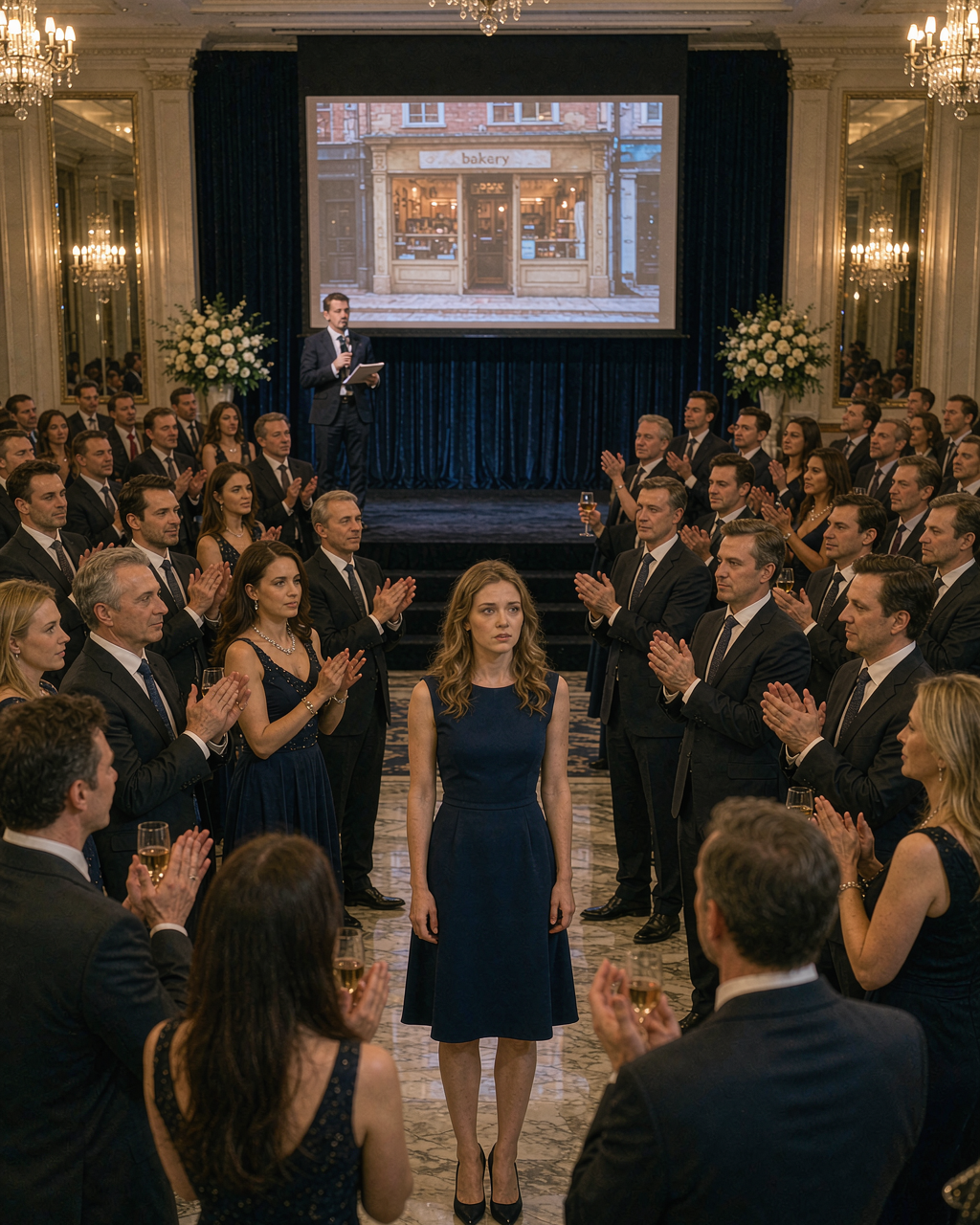
Then Adrian walked onto the ballroom stage beneath a photograph of my bakery.
"Tonight," he said, "Northstar welcomes Bell & Briar into our family."
Two hundred people applauded.
I did not.
Bell & Briar was mine. I had opened it with a used mixer, a $24,000 small-business loan, and six years of mornings that began at 3:30. The shop occupied nine hundred square feet on a busy corner in Baltimore. It employed four people and supplied pastries to three independent coffee shops.
Adrian had offered to invest twice. I had declined twice.
On the screen appeared a polished rendering: my green storefront turned silver, my handwritten logo replaced by NORTHSTAR BAKEHOUSE. A row of identical locations spread across a map.
Adrian spoke about scaling my "authentic neighborhood concept." He described centralized production and twenty planned hotel counters. Every sentence turned something specific into something he could own.
Then came a slide titled ACQUISITION AGREEMENT.
At the bottom was my name in blue script.
It looked convincing from thirty feet away. Up close, it was the signature from our wedding venue contract, copied with the same long tail under the final "r."
For weeks, Adrian's executive assistant, Lena, had asked me for vendor forms, monthly sales reports, and a high-resolution logo. Adrian said a Northstar hotel wanted to feature local desserts. The hotel's first order had been real: four hundred miniature pear tarts for a conference.
I believed the rest because it arrived disguised as more of the same.
Now I understood why his team knew my lease renewal date and the balance of my loan.
Adrian raised a champagne glass toward me. "And the best part? Claire will lead the brand after our wedding."
An event coordinator hurried over and whispered, "He wants you onstage for the surprise."
My phone showed three messages from Rosa, the manager I employed at Bell & Briar. Two men from Northstar had visited the bakery that afternoon to measure the kitchen. They told Rosa renovations would begin Monday.
Adrian had not expected my consent. He had expected the spectacle to make refusal too embarrassing.
I typed one message to Rosa: Do not let anyone in. Photograph every document they left.
Then I opened the draft email I had prepared weeks earlier, when Lena's requests became unusually detailed. It contained my two written rejections of Adrian's investment offers, my current lease, and a note from my accountant confirming that no sale had been authorized.
I added a photograph of the screen.
The coordinator touched my elbow. "Ready?"
"Absolutely," I said.
Part 2
I walked onto the stage, kissed Adrian on the cheek, and took the microphone from his hand.
"Thank you," I told the room. "Bell & Briar is the proudest thing I have built. That is why I need to correct tonight's announcement."
Adrian's smile stayed in place, but his hand closed around the stem of his glass.
"Northstar Hospitality has not acquired my bakery. I have not signed an acquisition agreement, licensed my name, or approved renovations."
I pointed at the blue signature. "That image appears to have been copied from my wedding venue contract. The two offers I actually received from Northstar were declined in writing."
Adrian reached for the microphone. I stepped sideways.
"Claire is overwhelmed," he said, loud enough for the front tables.
"I am very clear."
I pressed Send. The documentation went to Rosa, my landlord, my accountant, Northstar's general counsel, and the hotel buyers whose public email addresses appeared on the event program. I also sent it to myself at two accounts.
I did not accuse every person at Northstar of knowing. I stated what I could prove: I had not agreed, the displayed signature was not placed there by me, and no one had permission to enter my shop.
A woman at the board table stood. She introduced herself as the chair of Northstar's audit committee and asked the technician to freeze the presentation.
Adrian's confidence finally cracked. "This is a private misunderstanding."
"You put it on a forty-foot screen," I said. "It stopped being private."
I returned the microphone and walked out through the service corridor. Rosa was waiting at the bakery when I arrived. The papers Northstar's men had left were not construction permits. They were branded project schedules that described me as "founder and creative ambassador" with no salary listed.
We changed the alarm code, documented inventory, and emailed our suppliers that only Rosa or I could approve changes. My landlord confirmed that Adrian had called him about assigning my lease to a Northstar subsidiary. The landlord had not agreed, but he had assumed I knew.
At 1:00 a.m., Adrian came to the bakery.
He said the signature was a placeholder his strategy team had used by mistake. He said he planned to finalize everything with me after the gala. He said the expansion would erase my remaining loan and make me famous.
"You announced ownership before asking for it," I said.
"I was giving you security."
"You were giving yourself leverage."
He looked around at the scratched tables and mismatched chairs. "You are choosing this room over a national future."
I removed my engagement ring and placed it in the empty pastry case.
"I am choosing the right to decide what my future is."
Part 3
The next morning, Northstar issued a short statement calling the announcement premature. By noon, the audit committee had placed Adrian on leave while it reviewed the presentation and the use of my documents.
I hired a local business attorney, paid at her normal hourly rate, to send a demand that Northstar stop using my name, logo, financial records, and supposed signature. The letter did not solve everything. It created a paper trail and gave the company a clear deadline.
The evidence that mattered came from ordinary people doing their jobs. Lena retained emails showing Adrian had told the strategy team that I had given "verbal approval." The design firm produced the file Northstar sent them with my copied signature already attached. My landlord saved Adrian's voicemail asking him to keep the lease transfer quiet until after the gala.
Northstar's board terminated Adrian six weeks later for misrepresentations to the board and misuse of company resources. They did not do it for romance or justice. They did it because a CEO willing to fabricate one acquisition created a risk they could not quantify.
Adrian never faced a dramatic courtroom scene. Through counsel, he signed an agreement acknowledging that neither he nor Northstar owned any part of Bell & Briar. Northstar reimbursed my legal fees and paid for the emergency security changes. I declined a confidentiality clause because it was tied to money I did not need to accept.
Ending the engagement hurt in less cinematic ways. I lost deposits on the florist and photographer. I moved from Adrian's waterfront condo into a one-bedroom apartment above a pharmacy. For two months, I woke at night reaching toward Adrian's side of the bed.
At the bakery, the gala brought a rush of curious customers. I refused to sell pastries named after the scandal. Instead, Rosa and I used the attention to launch the wholesale plan we had already been testing.
One of the hotel buyers from the ballroom called me directly. The buyer had tasted our pear tarts before Adrian's announcement and still wanted them. Rosa and I negotiated a one-year supply agreement for two Baltimore properties, with volume limits my kitchen could actually handle and price increases tied to ingredient costs.
The contract helped me pay off the last $8,700 of my original loan early. It let me replace the failing oven and raise hourly wages by a dollar.
Adrian emailed once after his termination. He wrote that I had destroyed his career over a surprise intended to help me.
I did not answer. A gift transfers control to the receiver. What he offered required me to surrender mine.
On the first anniversary of the gala, Rosa found the engagement ring still sealed in an envelope in our safe. I had kept it while Adrian's attorney arranged its return.
We mailed it by insured delivery and spent the afternoon repainting the bakery's front door the same deep green it had always been.
There was never a chance to build twenty locations. There was only a plan someone made with my name while leaving out my voice.
Bell & Briar now closes at three on Sundays. I keep that afternoon for myself. No investor gave it to me. I built enough stability to claim it, one signed order and one clear boundary at a time.