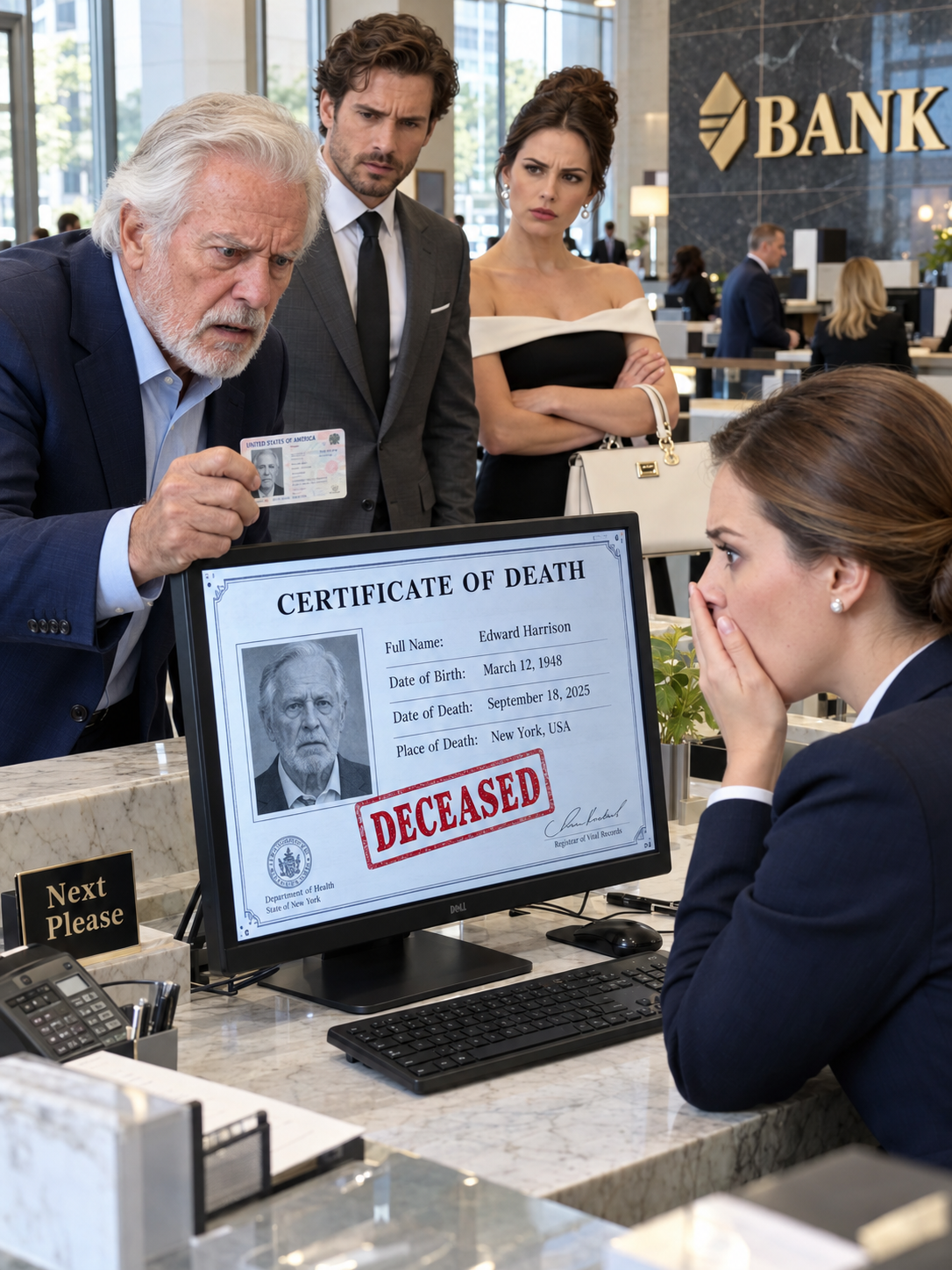
According to the bank's computer, I died on September 28, and my son had already asked to withdraw everything I owned. I was standing at the counter at the time, seventy-four years old and very much breathing, holding my driver's license and waiting for the Social Security deposit I collected every month. My name is Walter Dawson, and the reason I am telling this story is not the fraud itself. It is the signature underneath it, because my son did not act alone.
"Sir, you've been dead for twelve days."
The teller said it so gravely that for three full seconds I thought it was a terrible joke. Then she looked at her screen again, and her hands started to shake. "I'm so sorry, Mr. Dawson. The system shows you passed on September 28. Your son submitted the paperwork a week ago and asked to withdraw all your savings."
I did not argue with her. She was reading a screen, and I have photographed enough weddings to know that people believe the document in front of them. I asked for the manager.
Forty Years Behind the Camera
For four decades I was a wedding photographer in Asheville. I photographed thousands of couples promising each other forever, and if that teaches you anything, it is that some smiles hide lies. I learned to read the groom who gripped the bouquet too tight, the bride whose eyes wandered to the best man. I thought I had seen every way love can go wrong.
I never imagined I would end up photographing my own son to prove I was still alive.
My wife Margaret died four years ago after a long fight with cancer. Since then I lived alone in our house near downtown, kept up my little studio for portrait work, and saved. Forty years of disciplined saving came to $850,000 across my accounts, money I had told Gregory was his inheritance someday. Someday is not a word greed respects.
The Son I Defended for Too Long
Gregory is forty-seven and lives in Atlanta with his partner Denise. There were good years. There were also the loans that never came back, the business that failed, and the tempers that flared whenever money came up.
Denise, I learned much later, worked as an administrative clerk at the county vital records office. Hold that detail. It explains how a living man can be declared dead in a building where nobody has ever met him.
After Margaret died, Gregory called more often, and for a while I was grateful for it. Then the calls turned to the house, to my accounts, to what I planned to do with everything. When I mentioned a new will leaving a portion to the hospice that cared for Margaret, his voice went flat. "That's not what Mom would have wanted, Dad."
I let it slide. Family does that, and I had spent forty years training myself to let things slide in exchange for a quiet afternoon.
The Manager's Folder
The branch manager, a patient woman named Alvarez, led me into her office and pulled a folder. Inside were copies of everything.
A death certificate filed with the county, bearing an official seal. A funeral home document on letterhead. A signed request to transfer all funds to a joint account. And there, on the certification lines, two signatures I recognized. Gregory's, certainly. The second belonged to Denise.
His partner had reached into the death records system at her own office and manufactured my death from the inside, using a job that gave her exactly the access the scheme required. That is what people miss about fraud. It rarely requires genius. It requires one person with a login and another with a reason.
Alvarez was already on the phone with the bank's fraud division before I finished sitting down. "You're clearly alive," she said gently, "so let's keep it that way, and let's catch them."
Proving You Exist Is Harder Than It Sounds
Reversing a fraudulent death is a bureaucratic nightmare. The county registrar had a certificate on file, and unmaking it required a court order. Meanwhile my Social Security payments were suspended and my credit was freezing.
Three withdrawals over ten days had already drained $220,000 before the bank flagged the pattern. The fraud division froze the rest and, crucially, kept the final transfer request pending instead of rejecting it outright. A rejected request would have warned Gregory. A pending one kept him talking on a line the investigators could hear.
The bank's investigators, the county police, and eventually the state attorney general's office built the case. The funeral home document was fabricated; no funeral home existed at that address. The death certificate's medical certifier was a doctor whose name had been lifted from an obituary in another state. The withdrawn money led straight to a wire transfer toward a condo purchase in Gregory's name, in a development I have to admit had very nice views.
The Photograph That Ended It
Here is the part people find funniest, and I understand why. To certify my existence for the court, my lawyer suggested contemporaneous proof: a dated newspaper in hand, a notarized affidavit, and photographs.
I set up my tripod in the studio, sat on my own stool, and took the portrait of a dead man looking very much alive. The image went into the court file, and the clerk reportedly laughed for a full minute. I framed a copy. It hangs where clients can see it, and I tell them the truth: the only thing that saved me was that I walked into a branch where a teller knew my face.
Gregory and Denise were charged with identity theft, elder financial exploitation, and forgery. Her position at the vital records office, the very credential that made the scheme possible, turned it into an aggravated offense. They both took plea deals. Some restitution will take years. The condo was seized. I see Gregory at his sentencing hearing through glass now, the way I used to see grooms through a viewfinder, waiting for a smile that never comes.
What I Would Tell Any Older Friend
If you are retired and someone you love grows suddenly interested in your paperwork, pay attention. Check your credit reports twice a year, and read them the way I used to read a proof sheet, looking for the frame that does not belong.
Know that death fraud against elders is far more common than anyone admits, because a declared-dead parent cannot complain to the bank 【待补来源】. Keep one account nobody knows about, funded quietly, in a branch where the tellers know your face. That last piece of advice is not paranoia. It is the only reason I found out at seventy-four instead of at the reading of a will I never wrote.
The bank sent flowers afterward. I photographed them, dated the print, and hung it beside the portrait of the dead man who lived. Margaret would have laughed until she cried, and then she would have told me exactly what she always said at weddings, right before the cake: "Watch the ones who cry on cue, Walter. They've rehearsed."
What I understand now is that a signature is only as trustworthy as the person reading it. My son did not beat a bank. He beat a filing system that assumes the dead stay dead and the living stay quiet, and he would have won if a teller in Asheville had not recognized a face she had seen every month for a decade. That is a thin thread to hang a life on, and most people never find out how thin it is until they need it.