On the night Preston Hale was supposed to announce his engagement, a three-year-old girl took his hand, hid him behind a door, and showed him the woman he planned to marry threatening the child's own mother. He said nothing at the time. But hours later, he ordered security to review the cameras and the household payment records, and then he saw the first envelope, with his late mother's name written across the front.
This is how one of Atlanta's most careful businessmen nearly signed away his family's fortune, and how the least powerful people in his house saved him from it. The lesson is not that children are perceptive, although they are. A man who reads rooms for a living can still be the last person to read the one he has decided to trust.
The Girl Who Knew How to Be Quiet
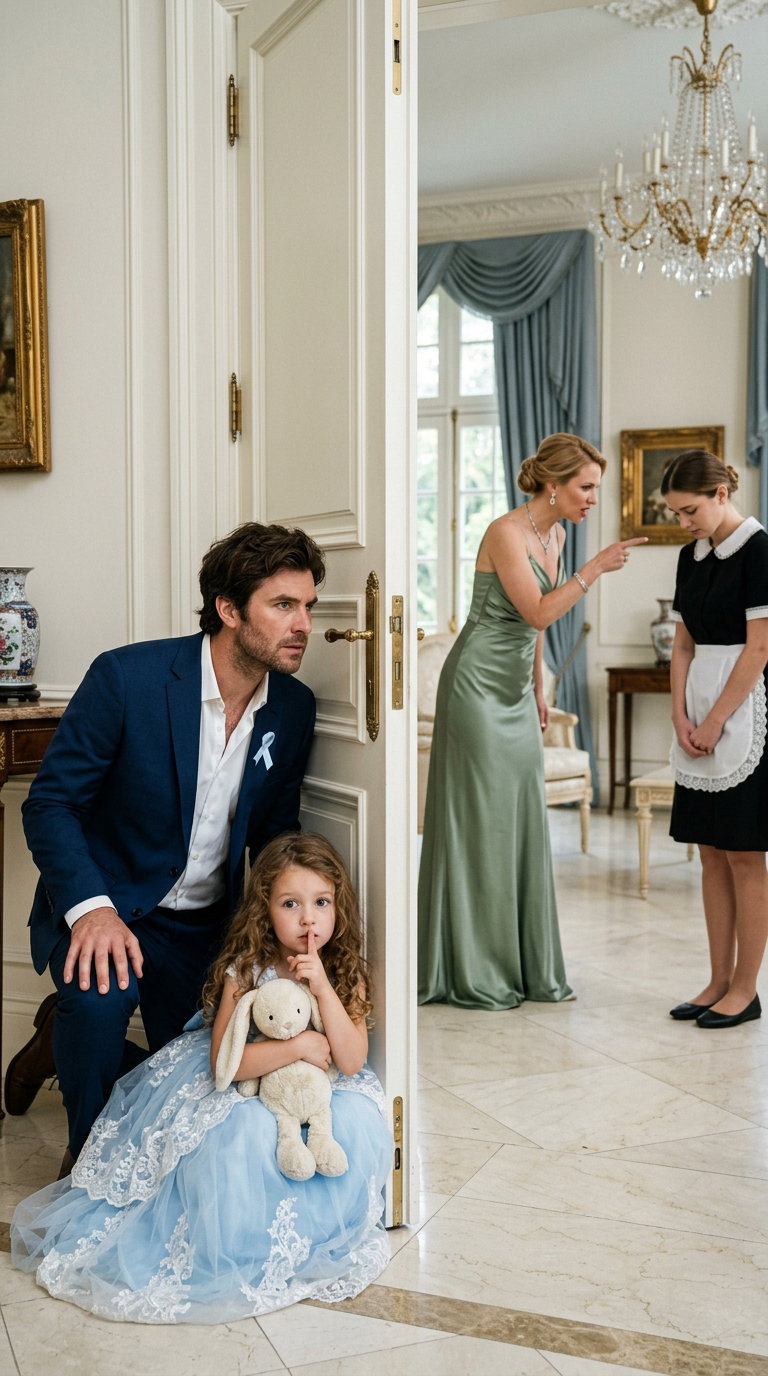
Lucia shouldn't have known how to stay that quiet. At her age, children ran down hallways, asked questions about everything, and turned every secret into a game. Not her. She walked barefoot across the marble floors of the Hale family estate in Buckhead like someone who had learned early that being unnoticed was safer than being seen.
"Shh... come on, Mr. Preston," she whispered, tugging his sleeve with absolute seriousness.
Preston, forty-two, ran a hotel group with properties in Atlanta, Savannah, and Charleston. He had watched executives tremble in boardrooms and partners change their minds at the sound of his last name. Yet that afternoon, he crouched behind a door beside a toddler, obedient as a schoolboy, because something in the child's face told him this mattered more than anything on his schedule.
What He Heard Behind the Door
Inside his mother Eleanor's bedroom, Vanessa Pierce, the woman he had proposed to three weeks earlier, was speaking to Rosa Delgado, the housekeeper who had worked for the family for six years and the mother of the girl holding Preston's hand.
"Tonight you're going to say, in front of Preston, that Eleanor asked you to keep me close to her," Vanessa ordered. "You'll say she trusts me and wants me in this family. You'll say she told you about the guardianship papers."
Rosa clutched a pillowcase to her chest. "I can't say that. Mrs. Hale has never said it. She never even met you."
Vanessa didn't even raise her voice. "Rosa. Tomorrow, you're out, and I'll make sure no one ever hires you again. Not in Atlanta. Not anywhere. You have a daughter to think about. Do you want to explain to her why there's no dinner?" That is how coercion sounds.
Preston's blood went cold, not because of the threat but because of the phrase that had slipped out before it. The guardianship papers. He had mentioned them to no one. His mother, in the final stages of her illness, had quietly updated her estate planning to protect the hotel group. No one outside his lawyer's office knew they existed.
The Investigation He Ran in Silence
He said nothing that evening, because a man who confronts on instinct teaches his opponent exactly what he knows. The engagement dinner went ahead, toasts were raised, and Vanessa performed warmth flawlessly. But the next morning, he called his head of security and ordered a quiet audit: camera footage from every common room, payroll records, and the household mail log.
The cameras showed Vanessa entering his mother's old study four times in two weeks, a room supposedly locked since the funeral. The payroll records showed Rosa's pay being processed through an agency that had doubled its fees since Vanessa began "helping" with administration. And then there were the envelopes. Six of them, mailed from the estate over the past three months, addressed in Vanessa's handwriting, one bearing Eleanor's name, all retrieved from the estate's outgoing mail by a mailroom clerk who had been told to divert them to Vanessa's assistant.
When investigators opened the intercepted envelopes, they found a pattern of forged correspondence: letters impersonating Eleanor, backdated, designed to establish that Preston's dying mother had endorsed Vanessa as her trusted proxy and confidante. The guardianship angle became clear. Vanessa intended to be installed as decision-maker over the estate trust the moment the family accepted her as Preston's wife.
The scheme was small, and it would have worked, because nobody audits the mail in a house where everyone is polite.
The Choice He Made for Lucia
Legal counsel advised Preston to let Vanessa commit to something irreversible before involving police. He staged the play she had written for Rosa. At a family dinner, Rosa repeated the false script, Vanessa smiled at her performance, and Preston calmly asked his lawyer, seated beside him, whether forging a dead woman's letters counted as a confession.
Vanessa's composure broke in front of twelve witnesses. Within weeks she faced charges including forgery and attempted fraud, and the agency managing the household payroll was dissolved under audit.
Then came the part that mattered more than the charges. He settled Rosa's family into one of the group's staff residences, made her head housekeeper of the entire estate, and set up an education fund for Lucia that his mother's lawyers later said would have made Eleanor laugh with delight.
The Smallest Hero in the House
People asked Preston afterward how a man so careful had missed so much. "I was looking at the woman. Lucia was looking at her mother." Children see what adults train themselves to overlook, the fear in a hallway, the silence where laughter should be, the door left half-open around a conversation someone doesn't want overheard. He had spent his career studying people who wanted something from him. He had never studied the people who had no power to ask.
The engagement ring went back to the jeweler. The cameras stayed up. And every Sunday, Preston has breakfast with Rosa and Lucia in the kitchen where the whole scheme first took root, because the family he almost lost his inheritance to was never the threat, and the family he almost overlooked was the one that saved him.
The truth about a house rarely arrives through the front door, and it almost never arrives in a suit. It comes in barefoot, holding your hand, and it expects you to crouch to its height and listen. The cost of not crouching is measured in six envelopes and a signature you came very close to giving away, and the only reason Preston still has his mother's company is that a three-year-old who had learned to be invisible decided, for once, to make someone see.