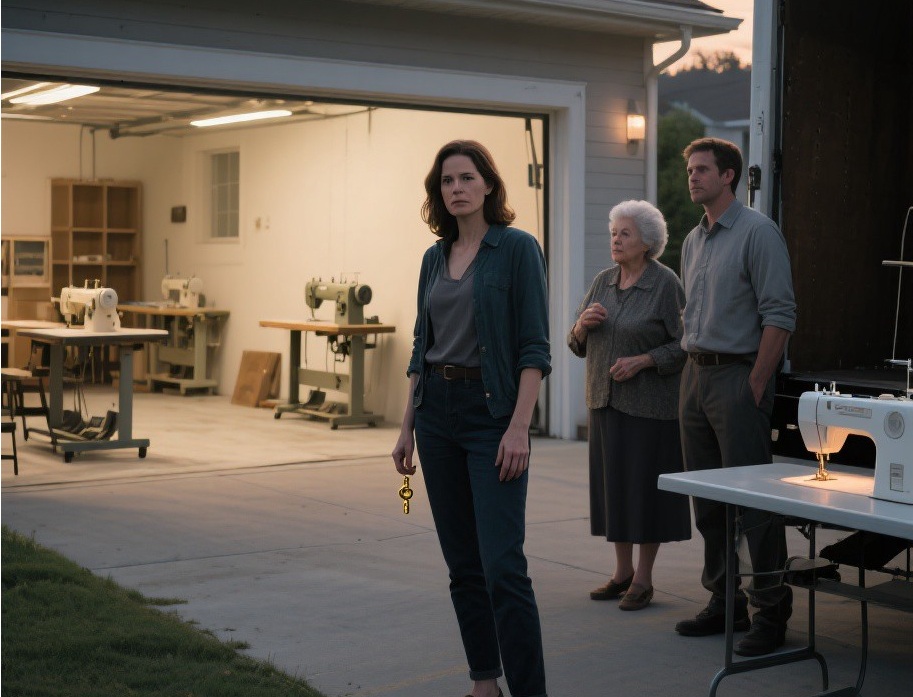
Four hours after my wedding, my new mother-in-law put a lease in front of me and told me to sign it or leave. My husband watched and told me to be grateful. I closed my iPad and said nothing, because the address printed above the word Tenant was a building I had owned outright for five years. That afternoon taught me something far more useful than how to win an argument: people who never ask you a question will always guess you wrong, and their guess is the only thing they ever really own.
The ink on my marriage certificate was barely dry when Katherine slapped the printed lease onto the dining room table. My name sat neatly beneath the word Tenant. Above it, the address of the Thompson family's upscale apartment. Below it, a number that made my stomach turn: one thousand five hundred dollars, due every month, for the privilege of sleeping under her roof.
"If you want to live in the Thompson apartment, you'll pay $1,500 a month!" Katherine announced, smiling with open contempt. "A woman from your humble background doesn't deserve to live in this neighborhood. Consider it a lesson in financial responsibility!"
I turned to my husband of four hours. "Are you really going to let your mother charge rent to your own wife?"
Brad set down his coffee cup with theatrical boredom. "Don't be so dramatic, Emma. You barely make anything at that pathetic job of yours. You should be grateful you married into this family."
Two things happened in that answer. He told me what he thought of my income, and he told me what he thought of the question. Neither one was about money. He was not defending a fair arrangement. He was telling me that in this family, the person who pays does not get a vote, and the person who does not pay does not get a voice.
The Trap They Thought They'd Built
Katherine had decided long before the wedding that I was an ambitious little climber who had latched onto her golden boy. She never asked about my work beyond a dismissive glance at my modest office clothes, and she never once invited me to contribute to family conversations about money. In her mind, my quiet demeanor and my small talk about scheduling shifts meant I earned pennies.
The assumption was convenient for her, because it made the lease look like generosity instead of control. A tenant can be evicted. A tenant can be inspected, reminded, and charged for a scratched floor. What Katherine wanted was not fifteen hundred dollars a month. She wanted a relationship in which she held the keys and I held the receipts, and the rent was simply the receipt she could point to.
What she never learned, because she never bothered to ask, was that I had bought my own apartment five years earlier. Not a rented one. Owned. Outright, after a modest software project I built in my twenties turned into a steady stream of licensing income, followed by a promotion I rarely mentioned at family dinners. Privacy had always felt safer than applause, and I had simply never corrected their assumptions.
So I smiled at the lease, slid it back across the table, and delivered the sentence that froze the entire room: "Then I'll just move back into my own apartment."
Brad's Jaw Hit the Floor
"You have your own apartment?" Brad repeated, as though the words were in a foreign language. Katherine's smile flickered like a dying bulb. She recovered quickly, sneering that it must be some cramped rental in a rough part of town, a closet she was embarrassed to imagine. "Fine. Go enjoy your little studio," she said, waving me off like a servant.
That is the second thing I learned that day. When a person has built an entire opinion of you on nothing, contradicting evidence does not change their mind. It makes them louder. Katherine could have asked one question. Instead she picked the answer that let her keep her original story intact: I must be lying, or I must be poor in a different way.
Brad chose his mother's side, of course. He phoned me that night to lecture me about respect, about family hierarchy, about how I had humiliated Katherine at his own celebration. I listened, said almost nothing, and hung up knowing exactly what the next move had to be.
He never asked to see the deed. He never asked what the apartment was worth or how I had paid for it. He asked me to apologize, which told me the only fact he cared about was the one where his mother was right.
Twenty-Five Guests and One Very Bad Bet
Katherine wasn't finished. She organized what she called a housewarming visit for the couple, but I recognized the production for what it was: an audience. She brought twenty-five relatives, cousins, aunts, in-laws, all primed to witness the poor little wife from the wrong side of town embarrassed in her element. She assumed I would cave, sign the lease, and begin paying her tribute.
Instead, I invited everyone to brunch before returning to my place for coffee. The address I sent made one aunt snort. "That's the Grandview Building. Nobody from this family could afford that." Katherine laughed loudest of all, certain I had mistyped the street number.
She had built the afternoon around a single assumption, and the assumption was the only thing holding the plan together. If I lived in a cramped rental, twenty-five witnesses would see me diminished, and the lease would look like mercy. If I lived where I actually lived, the same twenty-five witnesses would see something else entirely, and no amount of laughing would put it back.
When the elevator opened directly into my corner penthouse, with floor-to-ceiling windows, a river view, and my name on the ownership deed framed discreetly by the entrance, the silence was absolute. Twenty-five faces watched Katherine walk through my home, noting the piano, the art, the keys to a parking space worth more per month than her demanded rent.
The Confrontation She Never Planned For
"How?" was all Katherine managed. I explained politely that I'd owned the place since before I met her son, that my career in software paid for it, and that I had never needed a single dollar from the Thompsons. Then I turned to Brad in front of his entire extended family and asked one question: "When your mother tried to charge your wife rent, and you laughed at my job, which of us was the embarrassed one?"
He had no answer, because the answer required him to admit two things at once: that he had believed a story about me without checking, and that he had enjoyed believing it. Being wrong is embarrassing. Being wrong on purpose, in front of your relatives, in a penthouse you did not know your wife owned, is something else.
Relatives began quietly congratulating me. Two aunts scolded Katherine within earshot. Brad stood red-faced by my windows, suddenly understanding that the woman he'd dismissed had more assets than his mother's entire property portfolio.
The Decision That Followed
The apartment drama was the mirror I needed. A man who joined his mother in mocking me over a lease would never stand beside me when something harder came along. Within a month I consulted a lawyer, and before the year ended the marriage was quietly dissolved. Brad and Katherine spent months telling anyone who'd listen an increasingly implausible version of events, but the twenty-five witnesses had seen the deed with their own eyes.
I want to be careful about what I am claiming here. I am not saying the lease caused the divorce. I am saying it revealed a structure that was already in place. He had a picture of who I was, and that picture did not include a person whose judgment counted. The penthouse did not create that. It just made it impossible for me to keep pretending I had not seen it.
What I Tell People Now
People sometimes ask if I regret hiding my success. I never do. My quietness wasn't deceit; it was a filter, and it exposed exactly who belonged in my life. Katherine wanted a tenant. Instead she discovered a landlord, of my own life, on my own terms, with a river view and no rent due to anyone.
What I would add for anyone in a similar room, holding a similar piece of paper, is this: you do not have to win the argument on the spot. I could have produced the deed that afternoon and turned a wedding into a scene. I waited, and the waiting cost me a marriage I did not want and bought me twenty-five witnesses I did not have to convince. Some fights are won by answering immediately. Mine was won by letting the other person finish building the trap, and then declining to stand in it.