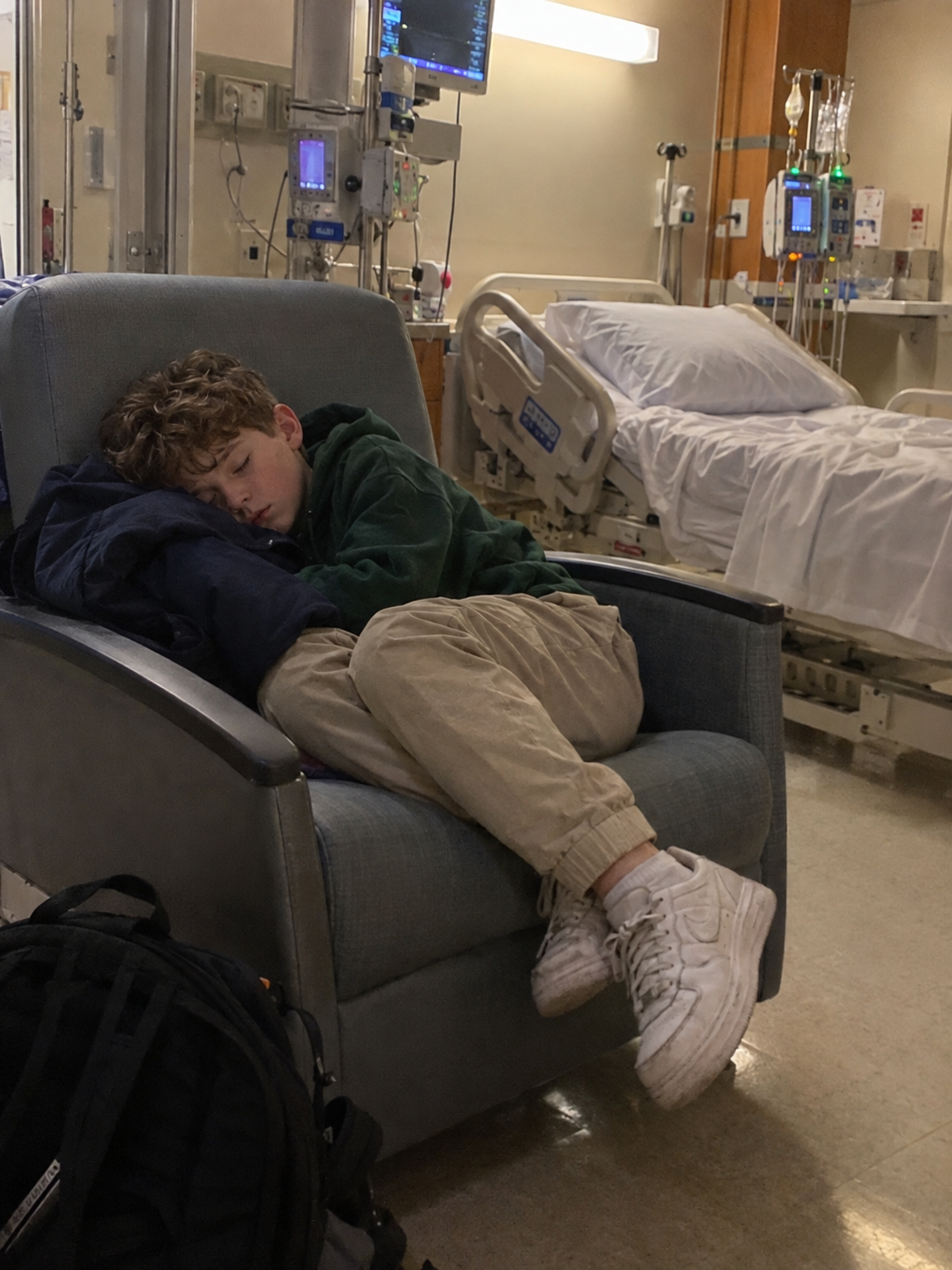
My nine-year-old grandson had been sleeping in a hospital chair for eleven days, and I thought it was grief. It was not. Milo was standing guard, and the whisper he gave me the morning I woke up was the first honest account of my family I had heard in years. I am writing this because I spent eleven days unconscious while the people around me decided what my life would be worth, and a child was the only one who told me the truth.
When I finally opened my eyes, I had no idea where I was. Tubes ran into my arm, a monitor blinked beside the bed, and a deep ache under my ribs made even careful breathing feel like work. A doctor explained that I had been unconscious since a serious car accident, and I was still trying to absorb how much of my life had vanished when I noticed the small figure curled up in the chair next to me.
It was my grandson, Milo. Nine years old, backpack stuffed under his feet, head resting on a folded jacket, one small hand still gripping the corner of my blanket as though he was afraid to let go. He had lived with me since his father, my son, died four years earlier, and I knew every expression that boy's face could make. The exhaustion I saw that day was one I had never seen before.
The First Thing He Did
"Milo?" I said softly. His eyes flew open. For a long second he just stared at me, as though his mind refused to believe what it was seeing. Then he launched himself out of the chair and wrapped both arms around me, crying so hard that his words dissolved somewhere between his chest and my shoulder.
"Granny!"
A nurse hurried in, and when she saw who was awake, her alarm softened into a smile. "He's been waiting for this. That little boy has barely wanted to leave your side." She told me Milo had spent hours in that chair every day, doing homework at my bedside, eating whatever the cafeteria ladies slipped him, refusing to go home. I ran my fingers through his hair and felt my heart crack in a way no broken rib could match.
I assumed then that he was simply frightened of losing me. That is what a child does when the last adult who loves him is lying under a monitor. I held him and told him I was fine, and he let me believe it for a while.
Then Milo lifted his head, glanced at the door, and leaned close to my ear.
The Whisper That Changed Everything
"Grandma, when my aunt comes back, pretend you're still asleep. Then you'll find out why I never left your side."
My aunt. My daughter, Corinne. The words made no sense at first, and then they made a terrible kind of sense. Corinne had called me exactly once in eleven days, a brief, distracted conversation about insurance paperwork. If my grandson was afraid of her, something was deeply wrong in the house where she had taken him.
I want to describe what that felt like, because it is not the fear you would expect. It was not terror. It was the specific nausea of realizing that a person you raised has been in the room while you were helpless, making arrangements, and that the only witness to it is nine years old and has been sitting in a plastic chair for eleven days because he did not know who else to tell.
So I did what he asked. When her heels clicked down the hallway twenty minutes later, I closed my eyes and breathed slowly, listening.
What I Heard From Behind Closed Eyes
"The house is going on the market Friday," Corinne said on her phone, her voice flat and businesslike. "Once it sells, he goes to his father's people. I'm not doing this out of charity, you know." A pause. "The boy's fine. He's quiet. He doesn't eat much - saves money, honestly."
I lay perfectly still while my stomach turned to stone. She was selling my house, the house I had left to Milo in my will, the house that held his father's memory in every room. And she was talking about my grandson like a line item in a budget.
The detail that stayed with me afterward was not the sale. It was the sentence about food. She had noticed that a nine-year-old did not eat much, and instead of worrying, she had found the advantage in it. That is the moment I stopped thinking of her as my daughter in any sense that mattered and started thinking of her as a problem with paperwork.
Milo hadn't left my side, I finally understood, because the hospital was the only place he felt safe. He had been guarding me the way I had always guarded him.
The Grandma Who Woke Up Angry
That evening I asked the nurses for my phone, called my attorney, and learned something Corinne had not counted on: my accident had triggered a review of my affairs, and nothing could be sold without documents she had quietly tried to forge. My lawyer had already flagged them. The forged power of attorney, the missing bank statements, the pattern of withdrawals from my account since the crash, it was all there, documented in a folder he had prepared while I slept.
I asked him one question before I hung up: how much time we had. He said the answer depended on how quickly we moved, and that the folder was already thick. That night I did not sleep much. I lay in the dark listening to my grandson breathe in the chair and understood that the accident had handed me a deadline I had not asked for.
When Corinne walked in the next morning with a smile, I was sitting up, breakfast tray pushed aside, attorney on speakerphone.
"Good morning, Corinne," I said. "Shall we talk about the house?"
Her face went white. Milo, who had been watching from the corner, smiled for the first time in weeks.
What Happened Next
The weeks that followed were quieter than I expected. Corinne's forgery case settled into a plea agreement; the estate fraud fell apart under scrutiny; and the sale was canceled before a single for-sale sign went up. She left town, and I did not chase her. Anger is heavy luggage, and I was too old to carry it.
What I will not pretend is that the quiet was the same as repair. A plea agreement is a legal ending, not a family one. For a long time after she left town, I kept expecting her to come back and explain herself, and I had to remind myself each time that the person I was waiting for had never really existed. The daughter I raised and the woman on the phone in my hospital room were not the same person, and only one of them was ever coming back.
Milo and I went home together in a taxi he insisted on calling "our carriage." He slept that first night in his father's old room with the door open, and I checked on him four times, just to see him breathing.
The Lesson I Keep Telling People
People ask what I learned from those eleven days. It is simple: children see everything, even when we think we are protecting them. My nine-year-old grandson had understood the danger long before I did, and his quiet vigil beside my bed was both a warning and a rescue.
What I would add is the part that took me longer to accept. Milo did not tell me because he was brave. He told me because he had run out of adults. His father was gone, his aunt was the danger, and the only person he trusted was unconscious. When he finally spoke, it was not a child being courageous. It was a child with no other option, and that is a thing we should be ashamed of, not proud of.
I nearly died in a crash, but I woke up to the truth. Now the house stands, the boy eats well, and every night he still whispers goodnight from the doorway, this time with a smile. I have not made him a promise that the world will be kind. I have made him a smaller, better one: if something is wrong in this house, you tell me first, and I will believe you before I believe anyone else.