Leonard Kensington had built a construction firm on the belief that every problem yields to patience, determination, and enough capital. What he learned on Christmas Eve was narrower and harder: capital only works when somebody decides to spend it on a person. A plate of pancakes taught him the difference.
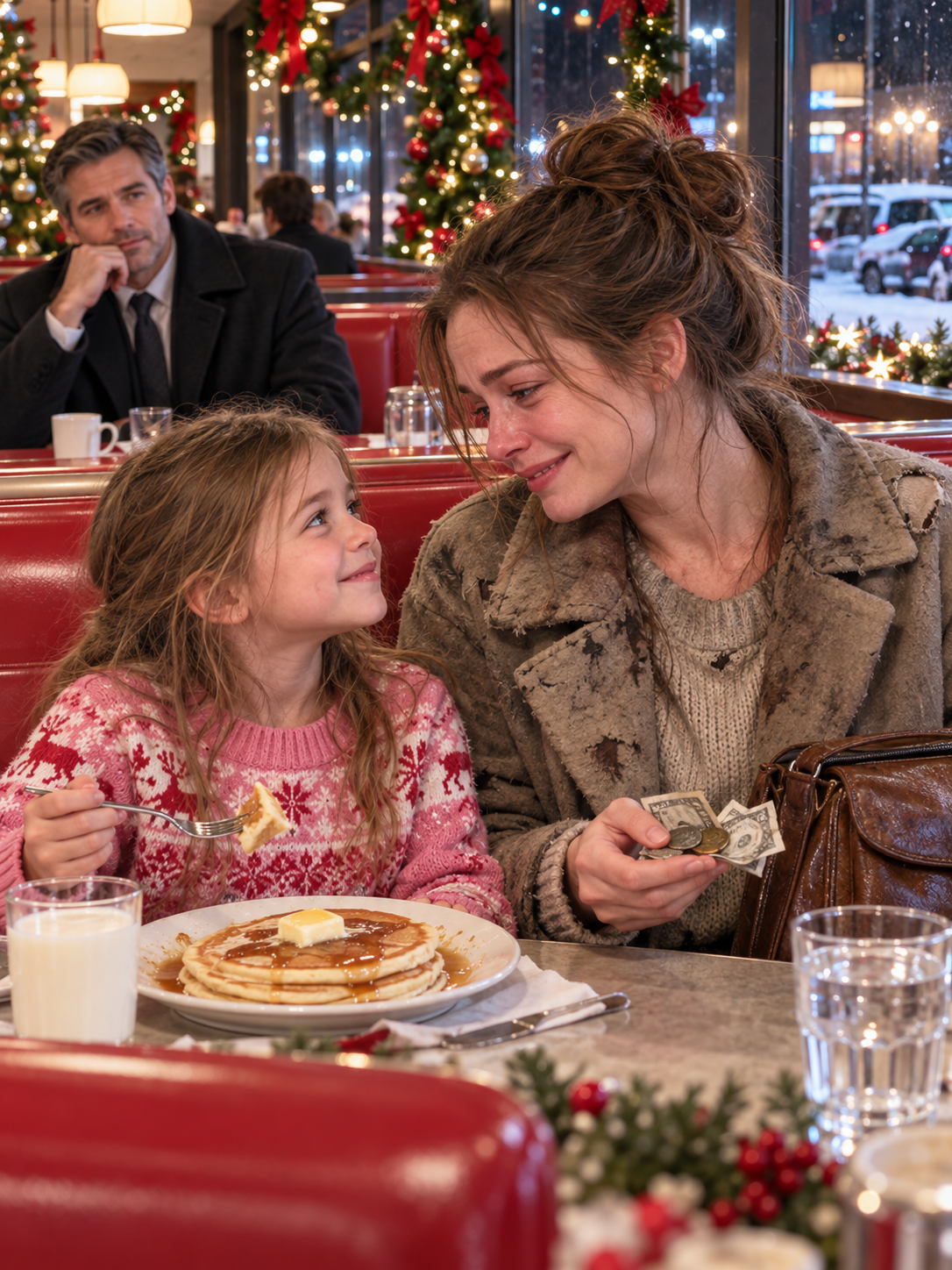
On Christmas Eve, in a small diner on the outskirts of Fort Wayne, Indiana, the wealthy businessman found himself watching a young mother count the money in her hand for the third time. She separated the quarters from the dimes with trembling precision, the way people do when they already know the answer and are praying the math has changed.
Leonard was fifty-nine, the founder of a thriving commercial construction firm, a man who had solved most of his problems by outlasting them. Lately none of that had touched the emptiness inside him.
A Man Running From a Silent House
Three years earlier, his wife Margaret had died after a sudden illness. She was the one who used to plan their holidays: the lights, the menus, the annual open house for friends and employees. Leonard had spent every Christmas since buried in work, pretending his endless hours were ambition rather than avoidance. That afternoon, his sister had called to invite him to her family's celebration. He declined, unable to sit among laughing children while feeling the crushing absence of his own.
So he was there instead, alone in a nearly empty diner with paper snowflakes on the windows, a small artificial tree by the register, and an old holiday song drifting from the ceiling speakers. He had chosen the room precisely because nobody in it knew him.
The Order That Broke Something Open
The young mother and her daughter, a girl of about seven in a faded winter coat, had been seated for a while when the mother finally flagged the waitress. "Just the children's pancake plate, please," she said gently, glancing at the menu prices. "And could we please have a glass of tap water?"
When the food came, she cut the pancakes into small bites, pushed the plate toward her daughter, and smiled. "Go ahead, sweetheart, eat while it's nice and warm." She herself ordered nothing.
Leonard's chest tightened. He watched the little girl offer her mother a piece, watched the mother insist she wasn't hungry, watched her hide exhaustion behind that warm smile. He had spent decades negotiating million-dollar contracts, and he could not remember the last time he had seen such quiet, complete self-sacrifice.
An Unexpected Intervention
Leonard rose, stopped at the register, and quietly paid for an entire dinner: a full hot meal for the mother, dessert, and a takeout box for the morning. He asked the waitress to say only that a friend had covered it. Paying anonymously was the easy part. What he did not know how to do was stay.
But as the pair bundled up to leave, he saw the mother glance out the window at the dark, snow-dusted street, and heard the girl ask softly where they would sleep that night. The answer, he realized with a sinking feeling, was nowhere certain. Food had been the visible problem. Shelter was the one behind it.
Something in him refused to let them walk into that night. He followed them outside.
"Excuse me, ma'am. I don't mean to frighten you. My name is Leonard. I overheard... well, I couldn't help noticing things tonight." He stumbled over words for the first time in years. "There's a warm motel room two blocks over, already paid through the weekend. And dinner for you tomorrow. No strings, no conditions. I just — I'd like to help."
The mother's eyes filled with wary tears. "Why would you do that for strangers?"
"Because someone once did it for me," he said, surprising himself with the truth of it. "And because it's Christmas Eve, and nobody should be counting quarters for their child."
The Night That Changed Three Lives
Her name was Rachel, he learned. Widowed that spring, she had been working double shifts at a warehouse and still come up short after the rent consumed everything. The diner dinner was the first proper meal her daughter, Grace, had eaten in two days.
Leonard drove them to the motel himself. Before he left, he wrote his direct number on a receipt, handed it to Rachel, and told her his company was hiring. "Show up Monday. I'll make sure the interview is a formality."
That last sentence is the one I keep returning to, because it is where charity becomes something else. A motel room ends in a few days. A job changes what a family can count on next month, and it asks something of the person offering it: a name, a number, and a willingness to be called.
A Year Later
When the next Christmas Eve arrived, Leonard's house, that enormous, empty house, was full. Rachel managed the front office at his firm and had rebuilt her life. Grace called him "Uncle Len" and had claimed the best chair at his table. The same diner, with its paper snowflakes, now hosted their annual dinner.
The waitress who had served Rachel's table that first night, a woman named Dorothy who had worked the Christmas Eve shift for twenty years, quietly gave pancakes away from her own pocket once or twice before. She later told a local reporter that regulars like Leonard were rare, but kindness between strangers at that counter was not. The diner added a small board by the register where customers can pre-pay meals for anyone who needs one, a tradition locals now call the Pancake Fund, started the year Leonard's story made the neighborhood paper.
Leonard had spent his whole life believing capital solved problems. It took a plate of pancakes and a seven-year-old's hungry eyes to teach him what Margaret had always known: the real wealth a man carries is measured by what he is willing to give away on the night he was supposed to be alone. The board by the register is the part that lasts, because it lets strangers do the same thing without needing a story to justify it.